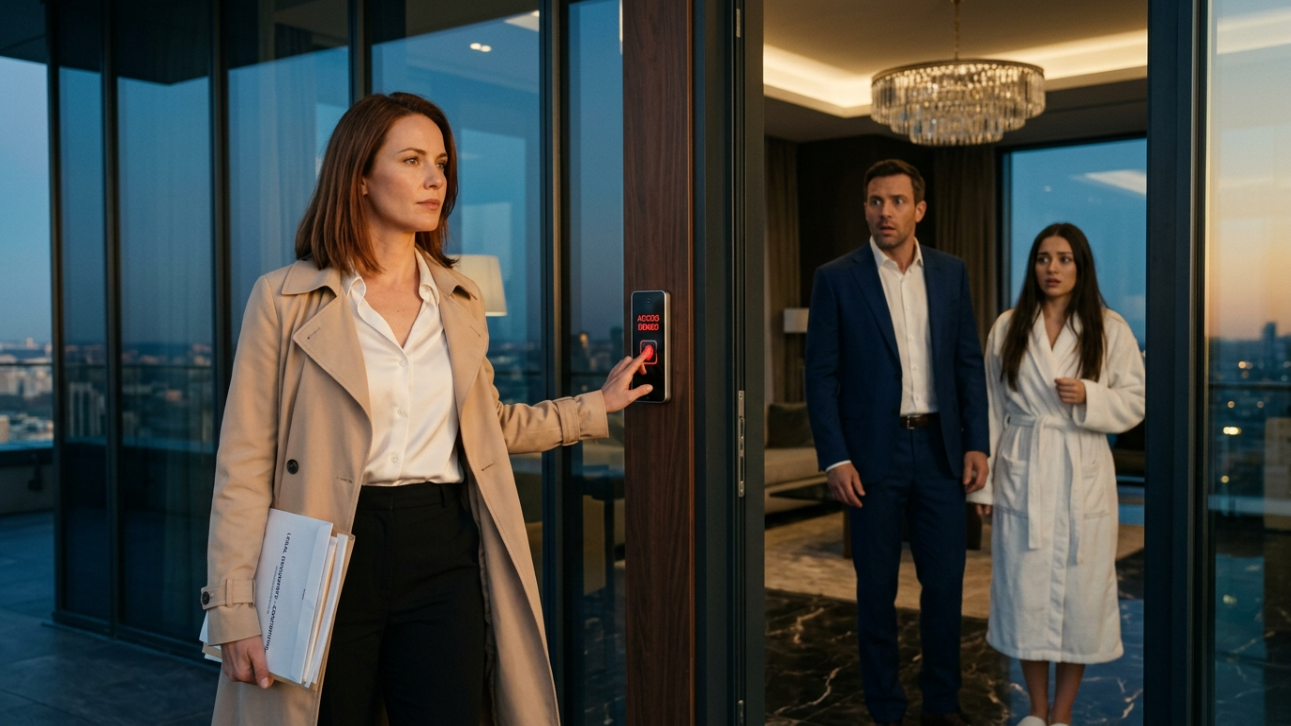
Part 2: I felt the exact same chill I had the day the lock denied me entry. It wasn’t because of the infidelity. That had already become crystal clear the moment April opened the door wearing my robe with a rehearsed calm on her face. The real blow was in that one phrase: I was listed as the primary debtor. Not the owner. Not a partner. Not a beneficiary. A debtor. I called my lawyer from the deck, with the ocean crashing below and a rage so clean that, for the first time, it didn’t make me shake. She had already pulled copies from the County Clerk and the notary’s office. The LLC was called Coastal Horizon Enterprises, and Matthew’s name did not appear directly on the incorporation documents. Neither did April’s. Instead, there was a straw man, and behind him, a line of corporate credit backed by my documents: my electronic signature, copies of my ID, bank statements, and a “spousal consent letter” that I had never signed. The penthouse wasn’t a gift, or a lovers’ nest, or an investment for “our escape.” It was collateral. If the deal went south, the bank would come for the LLC, and the LLC would come for me. I asked my lawyer to hold off on filing anything until we had gathered everything. Matthew was the kind of man who smiles in front of a notary and cries in front of a judge if he thinks pity will serve him better. That afternoon, he sent me forty messages. In some, he begged me to come back. In others, he claimed I was misinterpreting “administrative transactions.” Then he started getting nervous. He told me not to let anyone influence me, that April was just an employee, that the house was still “for both of us,” that the clause about incapacitation was just a standard asset-protection formality.
Protection. He had used that exact word the week he asked me to bring my biometrics to the bank “to speed up some paperwork.”
I didn’t answer him. Instead, I authorized my lawyer to enter my mother’s apartment with an investigator and secure any folder with my name on it. That very night, they found a blue folder inside a closet I hadn’t checked in months. Inside were drafts of power of attorney documents, an insurance policy with an altered beneficiary, an application for a sixty-million-dollar line of credit, and a letterhead from a medical office suggesting I exhibited “anxiety crises with dissociative episodes.” My full name, my age, my Social Security Number, and the signature of a psychiatrist who had never treated me.
That’s when I understood the entire trap. Matthew wasn’t just planning to put me in debt. He was planning to make me legally unreliable. An “unstable” wife with an active digital signature, assets in her name, a valid marriage, and family wealth is an easy mark for a man accustomed to corner offices, calling in favors, and speaking with an authoritative voice. If I complained, he would say I was having an episode. If I refused, he would present the paperwork. If I disappeared for a few days, he would trigger the power of attorney. If I stood my ground, the debt would drown me, not him. And in the middle of it all, April served two purposes: a bedmate and an errand girl.
My lawyer decided to move forward first with the criminal complaint for forgery, fraud, and identity theft. She also notified the IRS, the banks, the County Clerk, and the notary where April had tried to push the power of attorney through.
The response came faster than we expected. April asked to talk. Not to me, but to my lawyer.
She wanted protection. She said Matthew had promised her an apartment, not a felony; that she did know I was out of town, that he had asked her to register her fingerprint because “we need to get Claire out of the asset control,” and that a week earlier, he took her to sign some papers where he told her I was receiving psychiatric treatment and might “end up committed.”
She also handed over text messages. In one, Matthew wrote: “If Claire gets difficult, we trigger the voluntary disappearance clause. No one tracks people fast on a cruise ship.”
I read that line sitting in my cabin, my back pressed against the door, and for the first time, I felt true fear.
When I returned to land, I didn’t go home. I went straight to the law firm. Waiting for me were my lawyer, a notary public, and two detectives from the DA’s office. They laid out the documents, the audio recordings, and the screenshots on the table. Only one piece was missing: the original signature Matthew had been using for weeks to try and move the credit lines.
That piece showed up on its own, the way mistakes usually do for men who think they are smarter than everyone else.
My lawyer received an urgent alert from the bank where the corporate line of credit was to be opened: someone had just tried to reactivate my biometrics with an in-person appointment. It wasn’t April. It wasn’t a broker. It was Matthew. And he arrived accompanied by a man who signed in as the administrator of Coastal Horizon Enterprises.
They waited for him inside.
I didn’t go into the bank. I stayed in the car, watching the glass doors, until I saw him walk out escorted by two detectives, still adjusting his suit jacket, still trying to maintain the face of an offended executive. Before they put him in the patrol car, he turned to look at me. He didn’t apologize. He just said through gritted teeth: “You have no idea what you’ve just destroyed.”
And in that exact moment, my phone buzzed. It was a message from the Midtown notary.
They had opened the full corporate registry for the LLC and found a sealed addendum: if Matthew defaulted on the loan, the foreclosure wouldn’t hit the penthouse first. It would hit the only unencumbered property tied to my financial history.
My mother’s house.
