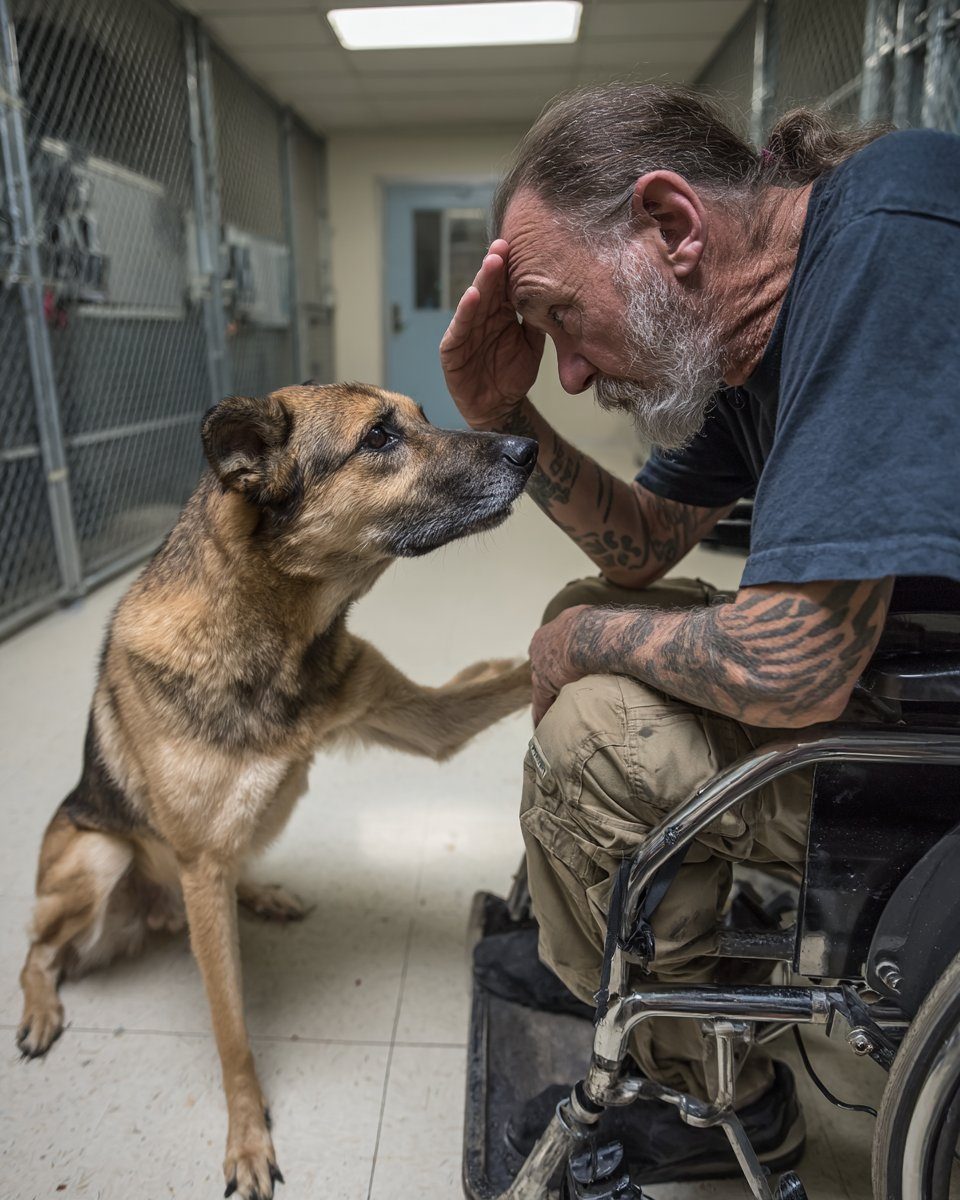
The rescue dog walked past every family in the shelter. Then she sat in front of the veteran in the wheelchair and raised her paw. Nobody had taught her that command.
—
The fluorescent lights in the adoption wing hum the same frequency as a migraine. I’ve managed the Jefferson County Animal Shelter for eleven years. I know the sound of every door, every kennel latch, every family that comes in saying they want to adopt but really just wants to look.
Saturday morning. March cold seeping through the concrete floor. Twenty-three dogs up for adoption. One German Shepherd mix in kennel 14 with a red tag on her file. Seven days. No interest. Bite history unknown. Found wandering Route 9 with no collar, no chip, no past.
The Sanderson family arrived at 9:15 AM. Two kids, matching North Face jackets, a mother clutching a printed checklist of dog breeds. They wanted a golden retriever puppy. We had a seven-year-old Shepherd mix who’d stopped eating.
I walked them past kennel 14. The dog—we’d been calling her Slate because of her gray muzzle—didn’t even lift her head.
“She’s older,” Mrs. Sanderson said, the way people do when they mean “next.”
I was about to lead them to the puppy area when the back door opened. Cold air. Wheelchair ramp scraping. A man rolled himself in alone, slowly, both hands shaking on the wheels. Late thirties. Marine Corps tattoo on his forearm. His jaw was locked in the specific way of someone who’d learned to swallow words because his throat wouldn’t make them anymore.
Nobody had called ahead. He wasn’t on the visitor log. He just sat there in the back corner, ten feet from kennel 14, staring at nothing.
Slate’s head snapped up.
I’ve seen dogs react to voices, to treats, to children. I’ve never seen a dog’s entire body go rigid like she’d been shocked.
She stood. Pressed herself against the kennel door. Didn’t bark. Didn’t whine. Just stared at him with the kind of focus that makes your skin crawl.
“Can we see the puppies?” Mrs. Sanderson asked.
I nodded, distracted. Slate wasn’t moving. The man in the wheelchair wasn’t moving. The air between them had gone strange and still.
I opened the puppy area. The Sandersons followed. But I kept one eye on the back corner.
Slate started whimpering. Low and continuous. The sound a dog makes when it’s trying to speak.
The man’s shoulders curled forward. His hands stopped shaking. He stared at her.
I walked back toward kennel 14, slowly. “You looking to adopt?”
He didn’t answer. Couldn’t. His eyes stayed locked on Slate.
I hesitated, then opened the kennel.
Slate stepped out carefully. Didn’t run. Didn’t jump. She walked in a straight line across the adoption floor, past the Sandersons, past two volunteers holding leashes, past every other person in the building.
She stopped one foot in front of the wheelchair.
Then she sat. Spine straight. Head high.
And raised her right paw.
Not like a trick. Not like a handshake.
She held it rigid at shoulder height, trembling, locked in place, eyes fixed on the man’s face.
A military salute.
Perfect form. Perfect stillness.
The kind of command you’d drill a K9 unit dog on for months.
The kind of command we’d never taught her. The kind of command no family pet would ever know.
One of the volunteers froze mid-step. Mrs. Sanderson’s mouth opened slightly. The kids stopped talking.
The man in the wheelchair stared at Slate’s raised paw. His breath caught. His whole chest locked.
Then his right hand lifted. Shaking. Slow. He touched his forehead. Dropped his hand to his chest.
A return salute.
Slate lowered her paw. Took one step forward. Rested her muzzle on his knee.
The man’s face crumpled. His shoulders collapsed inward. No sound. Just his whole body folding.
I looked at the red tag on kennel 14’s door. Scheduled euthanasia: Monday 8 AM.
Slate didn’t move. The man’s hand settled on her head, fingers buried in gray fur.
I crossed the room. Pulled the red tag off the kennel door. Folded it once. Dropped it in the trash.
“She’s spoken for,” I said.
Nobody argued.
The man’s hand stayed on Slate’s head. She leaned into him, eyes closed, breathing steady for the first time in seven days.
I didn’t ask his name. Didn’t ask hers.
Some recognitions don’t need language.
