The wire transfer receipt for fifty-eight thousand dollars had a faint purple ink smudge across the dealer authorization line. Harold, the senior auto broker at Fort Worth Luxury Motors, rubbed his thumb over the damp spot, leaving a gray smear on the heavy bond paper before sliding the document back across my desk.
“We can hold the registration for exactly seventy-two hours, Savannah,” he said, tapping his gold pen against his knuckles.
He adjusted his reading glasses, looking up at the digital clock on my office wall.
“But if you do not sign the title transfer by five p.m. on the third day, the state of Texas considers the sale null and the funds must be returned to your account.”
“That timeline fits my scheduling parameters,” I said.
I aligned the edges of the pending invoice with the corner of my mahogany desk, keeping my movements deliberate.
“Whenever a high-value asset is involved, paperwork comes first.”
Harold leaned forward, his face creasing with a brief, professional frown.
“Most daughters buying their father a milestone birthday gift want the registration finalized immediately,” he said.
“They want the license plates ready and the name on the registration card before they even hand over the keys.”
“My family operates under a different set of evaluation metrics,” I said.
“We prefer to verify the performance of the asset before completing the legal transfer.”
He nodded slowly, his pen scratching against the final line of the temporary authorization form.
“It is your money,” Harold said, sliding the clipboard closer to me.
“But remember, the dealership technically retains the vehicle’s legal ownership until your signature is notarized on page three of this packet.”
“I am fully aware of the custody parameters,” I said.
“I manage procurement contracts for an energy services firm, Harold. I do not sign for delivery until the cargo is inspected and accepted.”
“Fair enough,” Harold said, picking up his folder.
“We will keep the legal title transfer in pending status on our server until you call us on Friday afternoon.”
The seventy-two hour countdown was officially active, and my family had no idea that the luxury vehicle would arrive with its legal status still suspended in mid-air.
At half past three, the autumn sun hit the dealership lot in a hard, white glare that made the black paint of the King Ranch truck look like liquid asphalt under the Texas sky.
The vehicle was massive, smelling of fresh tire sealant, clear coat, and heavy wax.
Harold ran his hand along the chrome tailgate, pointing to the custom running boards that slid down automatically when the door handle was touched.
“It has the heavy-duty towing package and the upgraded suspension,” he said.
“Your father is going to be the envy of every contractor in Tarrant County.”
“He values utility over aesthetics,” I said, though I knew the badge on the side of the truck would matter to him more than the payload capacity.
“The side mirrors are heated,” Harold said, adjusting his cap against the sun.
“And they fold in automatically when you lock the vehicle.”
“That is a useful feature for tight parking spaces,” I said.
“My parents’ driveway has a low clearance from the pecan trees.”
Harold held out a heavy, dark wood box with a stiff red satin bow taped to the lacquered lid.
“The keys are inside,” he said, handing it to me.
“The transport service will need the spare set to move it to your parents’ address in Fort Worth.”
I took the box, its corners cold against my palms.
“The delivery must occur after five but before dusk,” I said.
“My father is meticulous about his driveway security, and he does not appreciate unscheduled vehicles on his street before the neighborhood watch starts their rounds.”
“We have the instructions on the manifest,” Harold said.
“Our driver, Gary, has done these high-end deliveries before, and he knows how to keep things quiet.”
I walked back to my own compact sedan, leaving the giant black truck sitting under the snapping dealer flags.
The drive back to my townhouse was a slow, hot grind through the afternoon traffic on Interstate 30.
I parked in my driveway at five o’clock, carrying my briefcase inside where the cool, filtered air of the hallway greeted me like a quiet contract.
On the kitchen counter, I laid out the unsigned title document, its blue security border matching the crisp lines of my company’s procurement contracts.
The transport driver was already waiting near the curb when I stepped back outside at five-thirty, his flatbed truck idling with a low, metallic rattle.
Gary was a thick-necked man wearing a gray uniform shirt with his name embroidered in red script above the pocket.
“I have the King Ranch on the flatbed around the corner,” Gary said, gesturing with his thumb toward the main road.
“You want it positioned nose-first or backed into the residential driveway?”
“Backed in,” I said.
“The dealer tags must be visible from the street so the neighbors know it is a transit vehicle and not a permanent addition yet.”
He handed me a clipboard with a yellow carbon sheet that smelled of mineral spirits and old grease.
“Sign the temporary custody sheet here, and I will drop the ramp.”
My hand was steady as I wrote my name, but the carbon paper left a blue smudge on my index finger.
“The keys in the wood box are for the presentation tomorrow,” I said, pointing to the garage.
“Use the magnetic key box under the rear bumper to park it tonight.”
Gary squinted at the address on his delivery slip, matching it against his digital GPS map.
“This is the brick house with the live oaks near the public park?”
“Yes,” I said.
“Leave the transport invoice in the glove box and lock the doors.”
“You got it, ma’am,” he said, pocketing his pen.
“If your father or the neighbors ask what I am doing, I will tell them it is a corporate transfer.”
“That would be best,” I said.
“My family is highly observant, and they prefer to ask questions before they offer congratulations.”
He climbed into his cab, the diesel engine coughing once before settling into a loud, rhythmic thrum.
I watched the flatbed pull away, the black tailgate of the truck disappearing around the corner of the block.
Back inside, the silence of the townhouse felt heavy and clean.
I walked to the powder room to wash my hands, scrubbed the blue carbon smudge from my skin, and dried them on a gray towel.
I stood at the kitchen counter, looking down at the unsigned title document under the warm light of the range hood.
The blank line for the buyer’s signature stared back at me, a clean white space waiting for my ink.
If I signed it now, the truck belonged to my father, and the transaction was legally finished before the first steak hit the grill.
If I kept it blank, the fifty-eight thousand dollars remained in escrow, and the vehicle was merely a temporary guest in his driveway.
My wristwatch hummed against my wrist, the digital display showing exactly five forty-five.
The dinner was tomorrow, and the family would already be setting the emotional scoreboard.
My mother, Martha, would have the white roses arranged in her crystal vase, her eyes tracking every detail of my appearance to ensure the family image was preserved.
My brother, Dean, would be practicing his sales pitch, eager to overshadow whatever contribution I made with his own exaggerated claims of success.
I checked my bank account on my phone, verifying that the escrow hold was still marked as pending.
The fifty-eight thousand dollars sat in a quiet financial limbo, waiting for a decision I had not fully made.
I picked up the document, the crisp paper rustling in the quiet room.
I walked to my desk, slid the sheet inside the top drawer, and pushed it shut.
The quiet click of my desk drawer closing on the unsigned document.
The drive to my parents’ house in Fort Worth took forty-five minutes on Saturday morning. I arrived at ten, the autumn wind already shaking the loose leaves from the post oaks in their front yard.
My mother, Martha, had the back door unlocked. She stood at the kitchen island with a bundle of white roses from the grocery store, her fingers working quickly to strip the thorns with a small paring knife.
“You should have bought the longer stems,” she said, without looking up as I walked in. “These are going to sink right into the crystal vase.”
“They only had the standard cut,” I said, setting my keys on the counter.
She picked up a rose and clipped the bottom of the stem at an angle. “Well, I suppose when you have a corporate budget, you don’t look at the details on the shelf. You just grab and go.”
“I looked,” I said, taking a handful of the discarded leaves and dropping them into the trash bin. “These were the freshest ones.”
She adjusted the collar of her shirt, her hand brushing her neck. “It must be nice to not worry about the price difference. Your father says the energy sector is still handed out blank checks.”
“We track every nickel, Mom,” I said.
She handed me the paring knife. “Here, finish these. My wrist is acting up from the damp weather.”
I took the knife and began cleaning the next stem. The cold water ran in the sink, filling the kitchen with the sharp, green scent of bruised flower stalks.
“Is Dad outside?” I asked.
“He is on the back patio,” she said, wiping her hands on a dish towel. “He has been out there since eight, scrubbing the grate. He wants everything set before Dean gets here.”
I finished the roses and placed them one by one into the heavy cut-glass vase. They looked slightly short, just as she had predicted, their white heads clustering tight against the rim.
“I will go say hello,” I said.
The sliding glass door to the patio was heavy and slid with a dull scrape. Outside, the air was cool, carrying the faint smell of lighter fluid and old charcoal.
My father, Frank, was bent over the large black barrel grill. He had a wire brush in his right hand and was scraping the iron bars with short, heavy strokes.
“You’re early,” he said, not turning around.
“Traffic was light on the interstate,” I said, walking to the edge of the concrete slab.
He stopped scraping and turned, leaning his forearm against the lid of the grill. His eyes went down to my feet, where my leather loafers sat on the clean patio stone.
“Those look like those high-dollar Italian slippers,” he said, gesturing with the wire brush. “Do they make those for walking on dirt, or just for sitting in those glass office buildings?”
“They are comfortable,” I said, keeping my hands in my pockets.
“I bet they are,” he said, turning back to the grill. “Probably cost more than the weekly payroll for my third-shift crew. Must be nice to get paid for sitting in meetings.”
“It is a lot of spreadsheets, Dad,” I said.
“Spreadsheets,” he grunted, giving the iron grate one final, aggressive scrub. “The world is built by people who use shovels, Savannah. The rest of you just write reports about the dirt.”
“The reports keep the shovels paid,” I said.
He polished his silver belt buckle with his thumb, his face tightening for a brief second before he let out a short, dry laugh. “If you say so. Just don’t go tracking mud into your mother’s house with those fancy soles.”
I stood there for a moment, watching the gray metal dust settle on the brick ledge of the patio.
“I will go help Mom with the table,” I said.
He did not answer, his arm already moving again as he resumed scraping the iron bars.
Back inside, the living room was quiet except for the ticking of the grandfather clock in the corner. My mother was spreading the white linen tablecloth over the dining table, her fingers smoothing out the creases with rhythmic, sweeping motions.
“He is almost finished with the grill,” I said, taking one side of the linen to help her align the corners.
“Good,” she said, her voice dropping to a whisper. “He gets anxious when things aren’t on schedule.”
She adjusted the center seam of the cloth, her eyes scanning the room as if checking for dust that did not exist.
“Your brother Dean should be here by one,” she said.
“Is he bringing anyone?” I asked.
“No, he is coming alone,” she said, smoothing a tiny wrinkle near the edge. “He has been under a lot of stress lately, Savannah. His territory got restructured last month.”
“I didn’t know that,” I said.
She stopped moving and looked directly at me. “Well, he doesn’t like to talk about it when things are tight. Especially not around you.”
“Why not around me?” I asked.
“You know how he is,” she said, her voice turning sharp. “He works hard, but he doesn’t have the same corporate backing you do. Try not to make everything about your achievements tonight, Savannah.”
I looked at the clean white linen between us. “I don’t do that, Mom.”
“Just let him have his moment,” she said, adjusting her collar. “He has some news about his sales bonus, and your father is very proud of him. We don’t need any comparisons.”
“I am just here to celebrate Dad’s birthday,” I said.
“I know,” she said, her tone softening slightly but remaining firm. “But you have a way of carrying yourself that makes people feel scrutinized. Just keep things simple.”
“I can do that,” I said.
She nodded once, apparently satisfied, and walked toward the kitchen to check on the meat.
I stood in the dining room alone. The grandfather clock chimed once for twelve-thirty.
The oak table was set for six. At the head of the table sat my father’s heavy wooden chair, its armrests worn smooth from years of his grip.
I walked to the window and looked out at the long concrete driveway. It was wide, empty, and clean, stretching from the street all the way to the side of the garage.
The delivery truck would be bringing the black King Ranch model later this afternoon, parking it right in that open space.
I reached into my pocket and felt the small, cold metal shape of my car key fob, though the keys to the new truck were still in the drawer at my townhouse.
I looked at my watch. It was ten minutes to one.
The emotional scoreboard was already active, the points being tallied before the first plate was even warmed.
From the front yard, the sharp sound of a car door slamming shut broke the midday quiet.
Dean carried two twenty-pound bags of ice, one cradled under each arm like heavy, sweating blocks of glass.
He dropped them onto the concrete porch with a wet, heavy thud.
Water immediately seeped through the thin plastic and began to darken the gray paint near my shoes.
“You are early,” Dean said, wiping his wet palms on the thighs of his jeans.
“I wanted to help Mom with the table,” I said.
He reached into his pocket and jangled a handful of loose quarters and keys.
The metallic sound was sharp and rhythmic in the quiet autumn afternoon.
“Well, you missed the heavy lifting,” he said, nodding down at the ice. “I just picked these up from the Texaco. Paid for them myself, too.”
“Thank you, Dean,” I said.
He leaned against the red brick pillar and looked out at the empty street.
“Things are finally turning around for me, Savannah,” he said. “I had my best quarter yet at the distributor. Cleared a real bonus last week.”
“That is excellent news,” I said, keeping my voice even. “I am glad to hear the market is responding.”
He smiled, but his eyes stayed narrow as he watched a leaf drift down from the oak tree.
“Twelve thousand dollars,” he said, his voice rising. “Cold cash, practically. I am thinking about putting a down payment on a center-console boat.”
“A boat requires significant seasonal maintenance,” I said.
“Some of us actually like to enjoy our lives,” he said. He jingled his coins again. “We do not all just stack our money in high-yield accounts and watch the grass grow.”
I looked down at my wrist.
My watch read exactly seven minutes past two.
“The ice is melting, Dean,” I said.
He grunted, snatched up the wet bags by their plastic ears, and kicked the screen door open with the toe of his boot.
By three o’clock, the heavy smell of roasting garlic and seasoned beef had drifted from the kitchen into the den.
My mother sat on the edge of the floral sofa, her posture perfectly straight as she folded white linen napkins into sharp triangles.
She was wearing her new emerald silk blouse.
The green was exceptionally bright under the yellow light of the floor lamp, casting a faint, rich color against her throat.
“He worked sixty hours a week for that bonus, Savannah,” she said, without looking up from her folding. “Every single Saturday in October.”
“I know,” I said from the armchair. “He told me on the porch.”
Dean was pacing near the television, his hands deep in his pockets, his chin held high.
“The regional director called me out by name in the morning meeting,” Dean said. “Said I was the benchmark for the whole North Texas territory.”
My mother smiled, her eyes turning soft as she looked at him.
“It is wonderful to see your hard work recognized,” she said. “Your father was just saying how much we need some good news around here.”
She turned her gaze back to me.
The soft look disappeared, replaced by the cool, assessing squint she used when checking for dust on the mantle.
“Some of us have to work twice as hard for our bonuses, Savannah,” she said.
The phrase hung in the warm room.
I did not correct her.
I did not mention the procurement override I had secured the previous Tuesday, or the signed retention agreement currently sitting in my desk drawer in Fort Worth.
“Dean deserves the credit,” I said.
My mother adjusted her emerald collar, smoothing the silk flat against her collarbone with two fingers.
“We just want tonight to be about family,” she said. “No competition, no bragging about corporate salaries.”
“I have no intention of bragging,” I said.
Dean stopped pacing and looked toward the hallway that led to the garage.
“Where is Dad anyway?” he asked.
Uncle Charles was standing near the curb when I walked outside at four o’clock.
He was wearing his usual khaki trousers and a starch-stiff plaid shirt, his hands clasped behind his back.
He was staring at the empty gravel turnaround beside the double garage.
It was the exact spot where my father usually parked his old, rusted utility trailer.
“Your mother made Frank move the trailer to the vacant lot down the road,” Charles said, his voice a slow, dry drawl. “Said it looked like a junkyard.”
“It does,” I said.
“Well,” Charles said, looking at the empty concrete. “Leaves a lot of space. You planning on parking something here?”
I kept my arms crossed against the cool breeze.
“I brought my sedan,” I said. “It is parked on the street.”
He looked at me, his eyes crinkling at the corners.
He whistled softly, a low, three-note tune that meant he was putting pieces together in his head.
“You have that look you get when you are about to sign a major supply contract,” he said.
“I am just here for the dinner, Charles,” I said.
“Sure,” he said. He reached into his pocket and pulled out a small silver pocketknife, turning it over in his palm. “But you do not usually drive all the way from the city just to watch your brother eat three pounds of ribeye.”
“It is Dad’s sixtieth birthday,” I said.
“That it is,” Charles said. “Sixty years of Frank being right about everything. That is a long run for any man.”
He looked down the street, where the oaks were dropping their dry brown leaves onto the asphalt.
“I hear Dean is buying a boat,” Charles said.
“He mentioned that,” I said.
“With what?” Charles asked.
I did not answer him.
My phone buzzed in my pocket.
I walked back inside and stood in the quiet of the formal dining room, where the table was already set for six.
I pulled the phone out and swiped the screen.
The text was from the delivery coordinator.
“The black King Ranch is parked in the side drive,” the message read. “Dealer tags are secured. Keys are in the delivery box on the front porch as requested.”
I deleted the message and slipped the phone back into my pocket.
“Are you hiding from the kitchen, Savannah?”
Aunt Brenda stood in the doorway, her breathy voice cutting through the quiet of the room.
She was wearing a pink cardigan that smelled strongly of lavender soap.
“Just checking the time,” I said.
“Your mother says you are very busy at the firm lately,” Brenda said, stepping closer to the table. “Though she could not quite remember the name of your new project.”
“We are restructuring our regional supply logistics,” I said.
Brenda covered her mouth with her linen napkin as she let out a high, breathy laugh.
“It sounds terribly dry,” she said. “No wonder you do not talk about it.”
“It keeps me occupied,” I said.
She reached out and adjusted one of the water glasses, moving it less than an inch to the left.
“Well, it is a blessing that Dean is doing so well,” Brenda said. “Your mother was saying he might even help his father with the roof repairs this spring.”
“That would be helpful,” I said.
The sound of tires crunching on the gravel turnaround outside cut through the house.
Two bright beams of light swept across the dining room window, illuminating the white lace curtains.
I turned toward the front door as the first guests arrived in the driveway.
Aunt Brenda and Uncle Charles came through the front door first, carrying a strawberry pie from the bakery on Eighth Avenue. Dean immediately started talking over Brenda, his hand deep in his pocket, jingling three quarters and a dime against his truck keys.
“We pulled fifty-four percent of the regional market share this quarter,” Dean said, leaning his shoulder against the doorframe of the dining room. “The Dallas office did not even touch our numbers.”
“That is very nice, Dean,” Martha said, smoothing her apron over her emerald silk blouse.
She adjusted her gold necklace, her fingers hovering near the collar for a second before she turned back to the kitchen.
Frank was already sitting at the head of the dark oak dining table, scraping a speck of dried polish off his belt buckle with his thumbnail. He did not look up when Charles walked in, but he pointed a blunt finger toward the kitchen counter where the clean glasses were stacked.
“Get yourself a beer, Charles,” Frank said. “Savannah bought some of that expensive imports stuff that tastes like grass.”
“Appreciate it, Frank,” Charles said, his slow drawl matching the hum of the refrigerator.
We sat down at seven. The ribeye steaks were thick and charred, filling the room with the heavy smell of seared fat and salt. Martha had laid out the fine china, the ones with the silver rim that only came out for funerals and decade birthdays.
“The price of steel is up four percent,” Frank said, cutting a piece of meat with a heavy hand. “We had to re-bid the entire warehouse project in Keller.”
“The Keller project is small change compared to what we are doing in Austin,” Dean said.
He leaned forward, his fork pointed at Charles.
“I am looking at a six-figure baseline for next year,” Dean said. “That is conservative.”
I looked down at my wrist. It was exactly ten minutes past seven. I did not mention that his firm had just laid off twelve percent of their field staff, or that his six-figure baseline was mathematically impossible based on their public SEC filings.
“Pass the salt, Savannah,” Dean said.
I handed the heavy crystal shaker to him without touching his fingers.
“Your sister has a big title now,” Martha said, setting a bowl of green beans on the trivet. “She is in procurement.”
“Procurement is just a fancy word for shopping with someone else’s checkbook,” Frank said, not looking up from his plate.
Brenda covered her mouth with her napkin as she laughed, her eyes darting between Frank and me to see if the blow had landed.
“It is about managing vendor risk,” I said.
“Sure it is, honey,” Frank said.
He chewed his steak, his eyes fixed on the empty space at the end of the table where the carving set lay.
By half past seven, the plates were mostly empty, leaving only the white grease congealing on the stoneware. I reached into my leather purse on the floor and pulled out the small black box with the red silk bow.
I slid it across the polished oak table until it stopped three inches from Frank’s water glass.
“Happy sixtieth birthday, Dad,” I said.
The room went quiet, the only sound the low rattle of the air conditioning unit in the hallway.
Frank looked at the box, then at Martha, then back at the box. He did not touch it for five seconds.
“What is this?” Frank asked.
“Open it,” I said.
He untied the red ribbon with one thick finger, letting the silk drop onto his greasy plate. He lifted the lid of the heavy cardboard box. Inside, resting on the velvet insert, was the electronic key fob with the silver running-horse emblem.
“Is this a rental?” Dean asked, his voice rising.
“It is not a rental,” I said.
Frank picked up the fob, his thumb immediately finding the lock button. He pressed it twice, and the distant, dual horn of a brand-new vehicle echoed from the concrete driveway outside.
We walked out together under the bright glare of the security floodlights. The autumn air was crisp, carrying the scent of dry oak leaves from the neighbor’s yard.
Sitting in the center of the driveway was the black King Ranch truck, its metallic paint reflecting the white light of the garage beams. The temporary dealer tags were taped flat against the rear window.
“Good Lord,” Charles said, whistling softly through his teeth.
He walked to the driver’s side and ran his hand along the chrome trim.
“This is the high-output diesel,” Charles said. “This is sixty thousand dollars of truck.”
“Fifty-eight thousand,” I said.
Frank did not say a word. He walked slowly around the front bumper, his hand trailing along the black hood. He stopped at the driver’s door and looked through the glass at the brown leather seats.
“You bought this, Savannah?” Frank asked.
“I did,” I said.
“With what?” Dean asked, his hands deep in his pockets, jingling his change so loud it sounded like a tambourine. “You took out a loan for this?”
“I paid cash,” I said.
Martha stood on the concrete porch, her hand pressed against her collar, adjusting the green silk fabric as if the cold wind had just reached her.
“It is beautiful, Frank,” Martha said. “Look at those seats.”
Frank pressed the key fob, and the automatic running boards slid down from the frame with a smooth, electric hum. He did not get in. He stood with his hand on the open door, looking at the temporary paper tag.
“We should go back inside,” Frank said. “The steak is getting cold.”
The strawberry pie remained untouched in the center of the table. Martha had poured the coffee, her hand steady but her eyes fixed on the tablecloth.
Frank stood up at the head of the table, his glass of iced tea held at chest height. He cleared his throat, his face slightly flushed from the walk outside.
“I want to say something,” Frank said.
The family looked up, Dean still leaning back in his chair with his arms crossed over his chest.
“I have worked thirty-five years in the dirt to keep this family in a brick home,” Frank said. “I never asked for handouts, and I never expected them.”
He looked directly at me, his thumb polishing his belt buckle.
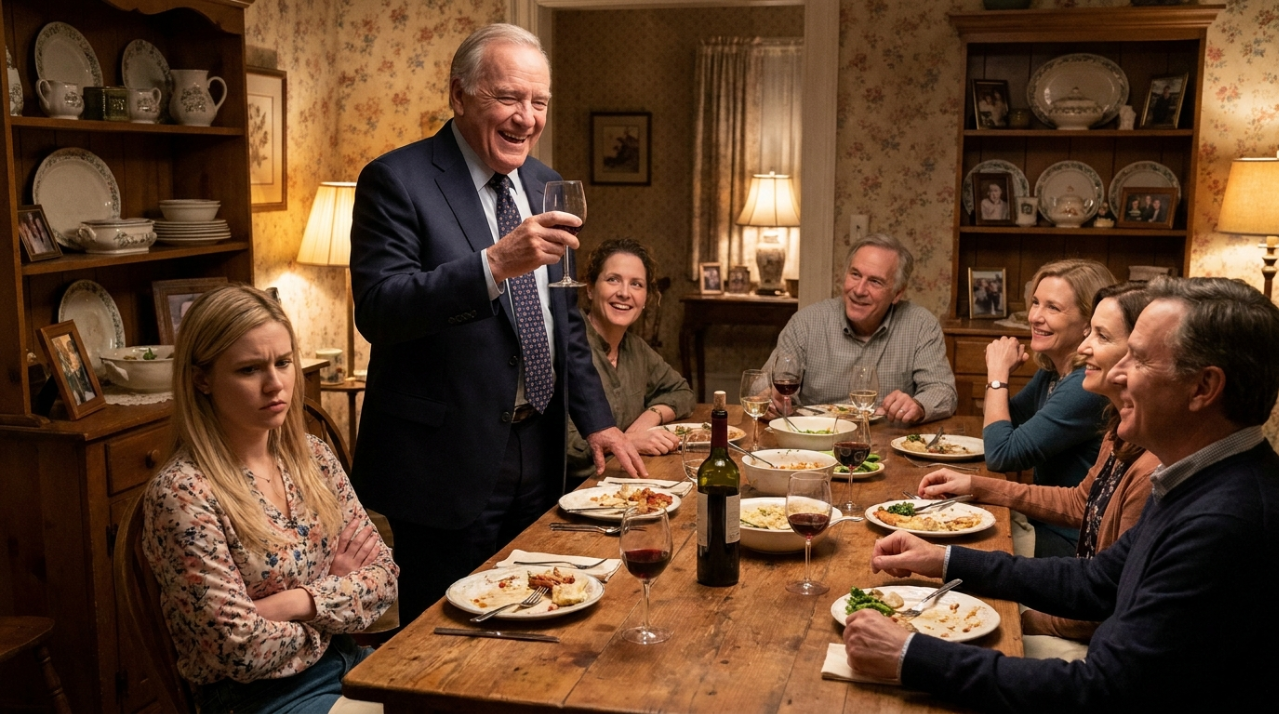
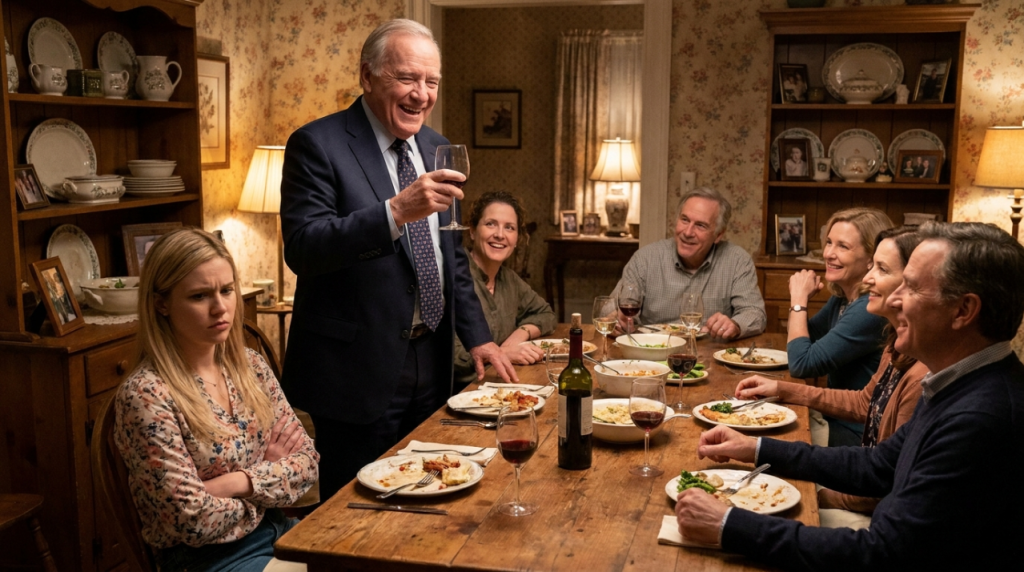
“Well, here’s to my idiot daughter, trying to buy love with money,” Frank said.
Dean let out a sharp laugh, and Brenda followed, covering her mouth with her linen napkin. Martha did not laugh, but she kept her eyes on her coffee cup, her finger tracing the gold rim.
I sat perfectly still. I looked at the grandfather clock in the corner, then down at my own wristwatch. It was eight-fifteen.
“The truck is paid in full, Dad,” I said, my voice flat.
“I know what it is, Savannah,” Frank said, sitting back down and taking a heavy sip of his tea. “It is a show. You always did like a show.”
I stood up from the table. I folded my linen napkin into a perfect rectangle and laid it beside my dessert plate.
I walked out of the dining room without saying another word.
The gravel of my parents’ driveway crunched under my soles as I walked toward my sedan, my keys already in my hand.
Behind me, the dining room windows shone with a warm yellow light, casting long shadows across the dark lawn. Nobody followed me out.
I got behind the wheel of my car, started the engine, and pulled out onto the road before I could look back at the black King Ranch truck parked under the security floodlights.
The digital clock on my dashboard read 8:45 p.m. as I reached the ramp for the highway back to Fort Worth.
The lanes were mostly empty, stretching into the dark Texas night under a sky that had turned a flat, dull charcoal. I kept my hands at ten and two on the steering wheel, watching the white reflective markers on the asphalt flash past in a steady, hypnotic rhythm.
My phone buzzed in the cup holder.
I did not reach for it.
The screen lit up three times before going dark again, the blue glow reflecting briefly off the passenger headrest.
I knew the road by heart, every bend and every exit, but tonight the distance felt twice as long. The headlights of an eighteen-wheeler flared in my rearview mirror, stayed there for three miles, and then bypassed me on the left.
By the time I pulled into my townhouse complex, the clock on the dash read 9:30 p.m.
The air in my kitchen was cool and carried the faint, clean scent of lavender laundry detergent. I walked straight to the sink, took a tall glass from the cupboard, and filled it with cold water from the tap.
I did not sit down.
With the glass in my hand, I walked into my home office and looked at the desk.
The unsigned title transfer document lay exactly where I had left it, its edges aligned with the corner of the dark wood. Fifty-eight thousand dollars was still my responsibility, locked in a holding pattern that only required my signature to release.
I picked up the paper, the crisp white sheet rustling in the quiet room.
The dealer hold on the transaction had twenty hours left before the registration went through automatically.
I pulled my phone from my pocket and unlocked the screen.
There were two missed calls from my mother, Martha, and one text message from my brother, Dean, that read, “Dad is still laughing about his toast.”
I deleted the text without replying.
I found the business card for the auto brokerage in my top drawer, the gold lettering of the logo slightly raised under my thumb. Below the main office number, there was a handwritten mobile number for Harold, the senior broker.
I tapped the numbers into my keypad and held the phone to my ear.
It rang four times before a gravelly, sleep-roughened voice answered.
“This is Harold.”
“Harold, it is Savannah,” I said, keeping my voice level. “I am sorry to call you so late on a Sunday.”
There was a brief pause on the other end, the sound of a rustling sheet, and then the quiet click of a bedside lamp turning on.
“No problem at all, Savannah,” Harold said, his tone shifting into his professional register. “Is everything alright with the delivery?”
“The truck is at the house,” I said. “But the transaction is not complete. I have the unsigned title document on my desk.”
“I see,” Harold said.
He went quiet for a moment, and I could hear the faint hum of his ceiling fan through the line.
“We have a seventy-two hour registration hold on our high-value vehicles,” Harold said. “If the buyer does not sign, the vehicle belongs to the dealership until the hold expires.”
“I want to cancel the transfer,” I said.
I looked down at the paper in my hand.
“We can have the transport truck there by seven, Savannah, but there is no turning back,” Harold said.
“I understand,” I said. “I want the truck retrieved before seven.”
“It will require a transport dispatch fee,” Harold said. “And the dealer hold will be flagged as a standard cancellation.”
“That is fine,” I said. “I will pay the fee.”
“I will contact our recovery driver, Vance,” Harold said. “He has the spare keys in our secure box at the lot. He can pick up the King Ranch model and have it back on our holding lot before the morning business hours.”
“Will he need me there?” I asked.
“No,” Harold said. “The transport driver has the temporary custody sheet you signed. He will just load it up and drive away.”
“Thank you, Harold,” I said.
“I will send the digital confirmation to your email within the hour,” Harold said. “Have a good night, Savannah.”
The line went dead.
I set the phone on the desk next to the unsigned document.
I walked back into the living room, checking the window locks one by one. The neighborhood was quiet, the streetlights casting long, pale rectangles across my hardwood floors.
I checked the front door, turning the deadbolt until it clicked into place.
I set the home security system to active, the small green light on the wall panel turning a solid, protective red.
My bedroom was cold, the air conditioning unit humming steadily in the window. I laid out my clothes for the morning, a plain navy blue suit and a white cotton blouse.
I picked up my phone from the bedside table.
I set the ringer to silent, the little icon of a bell showing a slash through it.
I placed the screen face down on the nightstand.
At ten o’clock that evening, thirty miles away in Fort Worth, my mother was standing at her kitchen sink. I knew the scene because I had watched her perform it after every family gathering since I was a child. She would have her yellow rubber gloves on, the ones she kept tucked under the cabinet next to the lavender-scented dish soap, scrubbing at the grease on the roasting pans with meticulous, rhythmic strokes. The rest of the house would be quiet, the guests having departed through the front door, leaving only the lingering smell of charred ribeye and warm pecan pie in the drapes.
My father would be sitting at the wooden breakfast table, probably scrolling through his phone or nursing the last few ounces of a Shiner Light. He would still have his boots on, the ones with the worn leather heels that scuffed her freshly waxed linoleum whenever he turned his ankles.
“You were hard on her, Frank,” Martha said, keeping her voice low so it would not carry down the hall to the guest room where my brother Dean was staying.
Frank did not look up from his screen. He adjusted his posture in the wooden chair, his thumb grazing his brass belt buckle, the one with the registered Texas Longhorn emblem he won at the county fair. “She has forty-five people reporting to her and makes twice what I do. If she cannot handle a joke at her own table, she shouldn’t have bought the damn thing.”
Martha dried a white porcelain plate with a red-and-white checkered dish towel, her movements precise and quiet. “She was trying to do something nice for your milestone.”
“She was showing off,” Frank said, dismissing her with a short grunt before reaching into his shirt pocket. “She wants everyone to know who has the deep pockets now. It is in the driveway, isn’t it? The keys are right there on the counter.”
Martha set the plate in the wire drying rack. “Dean was asking if he could borrow it for his sales trip to Lubbock next week.”
“Dean has some pride left,” Frank said, standing up to stretch his back. “He knows what it looks like when a girl tries to run the family.”
“Still,” Martha whispered, her hand rising to her collarbone where her new emerald silk blouse was buttoned to the top. “You didn’t have to call her an idiot in front of Charles and Brenda.”
“She knew what I meant,” Frank said, turning toward the hallway. “She has a thick skin. She gets that from me.”
At midnight, my townhouse in Fort Worth was completely silent. I had set my phone to silent and placed it face down on the nightstand, but the pale blue glow against the wall was hard to miss in the dark room.
I reached out, my fingers finding the cold glass screen, and swiped to answer.
“Savannah?” my mother’s voice was pitched low, the way she spoke when she was trying not to wake my father in the next room.
“I am here, Mom,” I said, sitting up in bed and pulling the quilt over my knees.
“I just wanted to make sure you got home safe,” she said, though her breath was shallow on the line. “The highway can be so dark near the loop.”
“I have been home for two hours, Mom.”
“Well, I wanted to call anyway,” she said, pausing to let the silence hang. “Your father and I were just talking about the dinner. It was a lovely evening, Savannah. The steaks were cooked just right.”
“The steaks were fine,” I said.
“Your father was just tired, you know,” she said, her voice dropping into that familiar, soothing register she used whenever Frank went too far. “He had that sixty-hour week at the Westover Hills job site, and then all the excitement of the birthday. He was completely overwhelmed by the big gift.”
From the background of the call, through the receiver, I heard a distinct sound. It was the low, rumbling chuckle of my father, followed by the dry clink of ice against a glass.
“Tell her she needs to get the oil changed at five thousand miles,” Frank called out, his voice muffled but entirely clear. “If she can figure out how to open the hood.”
He laughed again, a wet, heavy sound that carried through their hallway.
“He doesn’t mean anything by it,” Martha said quickly, her voice rising to drown him out. “Your father has a unique sense of humor, Savannah, you know how he is.”
I looked at the digital clock on my cable box across the bedroom. It was twelve six.
“I know exactly how he is, Mom,” I said.
“He is already planning where we should take it this weekend,” she continued, her words rushing together like water down a storm drain. “We might drive down to the river lot. Dean wants to go with him. It will be a nice family outing, and we want you to come with us.”
“I have work on Monday,” I said.
“Well, we can talk about it tomorrow,” she said. “You will feel much better about everything once you’ve had some sleep. We love you, Savannah.”
“Goodnight, Mom,” I said.
I pulled the phone away from my ear and ended the call, placing it back on the wood table.
I lay back down on the pillows, the room returning to its dark, still state.
The outdoor compressor for my air conditioner kicked on with a low, metallic thud, followed by the steady hum of air rushing through the ceiling vents.
I listened to the sound, counting the seconds between the cycles.
The silence in my bedroom was different from the silence in their house. Here, every corner was paid for, every piece of furniture selected and delivered by people I had hired with my own earnings. There were no invisible scoreboards hanging over the dinner table in this townhouse.
But thirty miles away, the black King Ranch truck was sitting in their concrete driveway under the security floodlights, a heavy, silent monument to my attempt at buying their approval.
It was a beautiful machine. I recalled the way the dealership lights had reflected off the dark paint, the clean lines of the chrome grille, the way Uncle Charles had whistled when he looked at the dual exhaust.
But to my father, it was just another tool to keep me in my place.
He would drive it to his construction sites, he would show it to his foreman, and he would tell everyone who asked that his daughter had bought it for him because she had more money than sense.
And my mother would continue to call me at midnight, reminding me that we were a family, that Frank was just old-fashioned, and that I was the one who needed to maintain the peace.
They expected me to apologize.
They expected me to show up at the next Sunday lunch, sit in my usual chair, and pretend that the toast had been nothing more than a playful joke.
If I did not, I would be the cold one. The daughter who held a grudge.
I turned over, the cool sheets sliding against my skin, my decisions hardening in the dark.
At exactly one in the morning, I got out of bed and walked down the hallway to my home office.
I did not turn on the overhead light. The soft glow of the streetlamp outside the window was enough to guide me to the desk.
I sat down in my leather swivel chair and opened my laptop.
The blue light of the screen illuminated the neat rows of files, the pending contracts, and the digital calendar that filled my weeks with logistics and procurement targets.
I opened my email client.
There was an unread message from the transport coordinator at Harold’s dealership, timestamped twelve forty-eight.
The subject line was short: *Revised Dispatch Order 4409.*
I clicked it open.
The email contained a digital map of the Fort Worth area, with a small blue icon representing the transport flatbed. Below the map, the details of the recovery were laid out in the clear, contractual language I used every day at the firm.
*Asset: 2024 Ford F-250 King Ranch. Location: 1412 Meadowbrook Lane. Destination: Holding Lot B.*
The transport company had a driver on the night shift who was scheduled to begin his route at six thirty.
At the bottom of the email, a green button was labeled *Confirm Retrieval*.
I knew what would happen if I clicked it.
The driver would arrive before the sun was fully up. He would back his trailer into my parents’ driveway, hook up the black truck, and drive away before my father had even finished his first cup of coffee.
The neighborhood would see it. Aunt Brenda’s husband, who lived three houses down and spent his mornings watching the street from his porch, would see it.
The sixty-thousand-dollar gift would be gone, replaced by an empty concrete driveway.
My hand did not hesitate as I moved the cursor over the green button.
I pressed the trackpad down.
The screen flickered for a second, then updated with a confirmation message: *Retrieval Scheduled for 7:15 AM. Notification sent to broker.*
I reached for the edge of the screen and pushed it down, the screen of my computer going black as I shut it down.
The air was forty-eight degrees when the flatbed transport truck turned onto the asphalt of my parents’ cul-de-sac. The gray morning light was just beginning to touch the tops of the live oaks, casting long, pale shadows across the manicured lawns. A light frost clung to the edges of the blue recycling bins lined up at the curbs, making the plastic look silver under the streetlamps.
The yellow warning lights on the truck’s cab were switched off to keep the recovery quiet, but the hydraulic lift hummed as it tilted toward the concrete. The sound was a low, mechanical growl that echoed off the brick fronts of the quiet houses, a steady vibration that seemed to travel through the foundations of the neighborhood.
The driver, a man named Jesse whom Harold had dispatched from the auto brokerage, did not look at the windows of my parents’ home. He focused entirely on the black King Ranch truck sitting in the driveway, its polished paint catching the thin dawn light like wet asphalt. Jesse parked his rig parallel to the curb, leaving the diesel engine idling with a rhythmic rattle that vibrated through the dead leaves on the parkway.
He climbed down from the high cab, adjusting his grease-stained cap against the chill. He carried a heavy aluminum clipboard with the dealership invoice and a set of master keys that jingled against his heavy canvas trousers. He walked around to the rear of the flatbed, his heavy work boots crunching softly on the gravel at the edge of the road.
