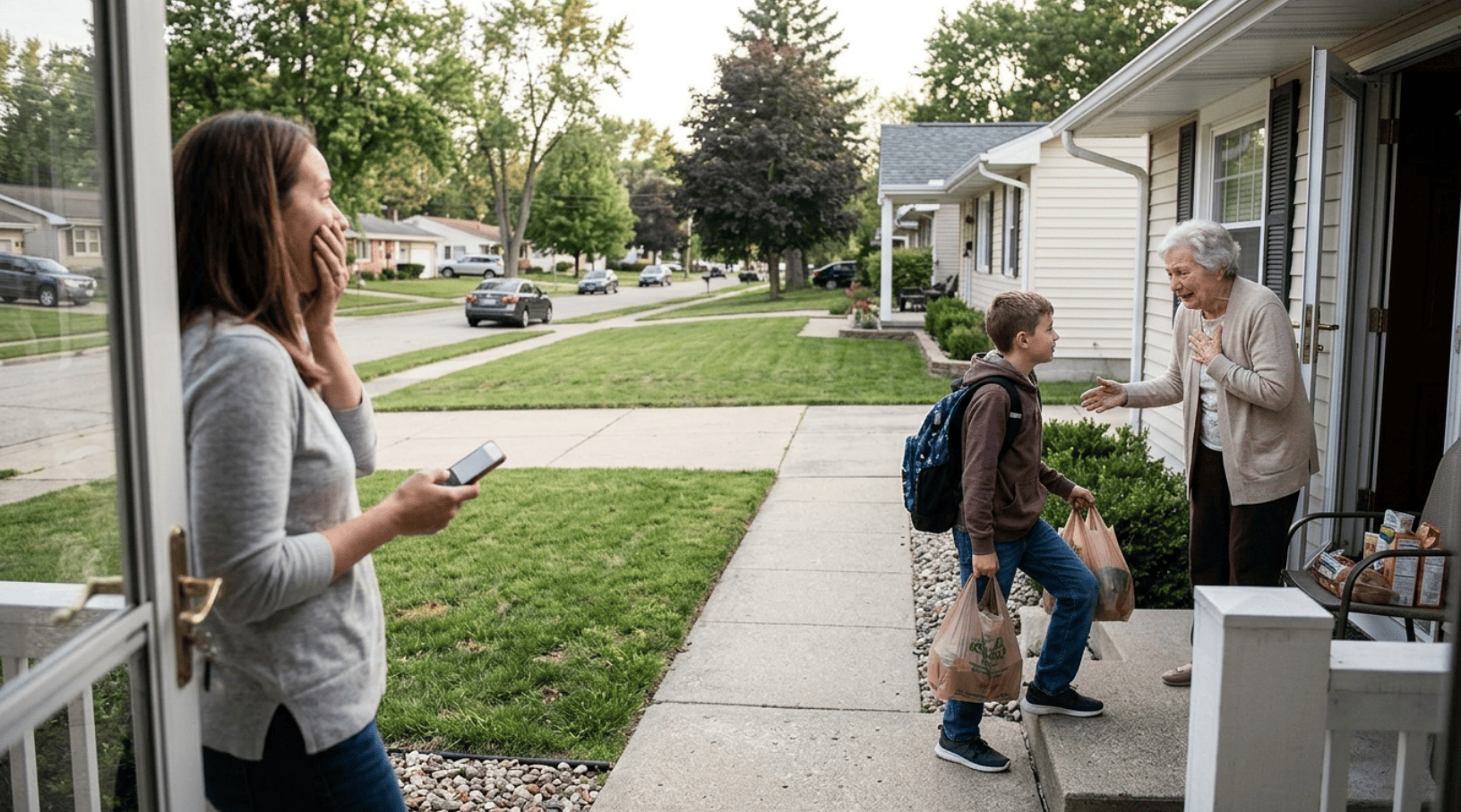
PART 3: The Secret Behind What My Son Did
The elderly man lowered his head.
Joel continued.
“I asked him if he needed help. He said he was fine, but he was shaking so much that he dropped his bag.”
I looked at the groceries.
“Where did all this food come from?”
“My lunchbox,” Joel whispered. “I gave him my sandwich first. Then I used the money in my backpack.”
My eyes widened.
“You used your allowance?”
He nodded.
“I had twelve dollars.”
I stared at him.
Twelve dollars was the money he had been saving for weeks to buy a remote-control car he had seen in a toy store.
He had talked about that car almost every day.
“You spent all of it?”
Joel looked down at his shoes.
“He said he hadn’t eaten since yesterday.”
The elderly man finally spoke.
“Your son is a very good boy, ma’am.”
His voice was weak and unsteady.
“I told him not to buy me anything. I told him to go home. But he wouldn’t leave me sitting here alone.”
I felt a strange mixture of relief, confusion, and pride.
But then I noticed something else.
The old man’s left hand was pressed against his chest. His breathing seemed shallow, and his face had an unnatural grayish color.
I immediately pulled out my phone.
“I’m calling an ambulance.”
He shook his head.
“No, please. I don’t want to cause trouble.”
“You’re not causing trouble,” I replied firmly. “You need help.”
While I spoke to the emergency dispatcher, Ivy stepped closer to me.
She was still crying.
I glanced at her.
“Ivy, why are you so upset? What happened before I arrived?”
She pressed a hand over her mouth.
Then she pointed toward Joel.
“Because your son did something I haven’t seen another child do in years.”
I looked at her, waiting.
She took a shaky breath.
“When I came outside, he was kneeling beside that man, holding his hand. He was telling him that he wasn’t alone and that somebody would come to help him.”
My throat tightened.
Ivy wiped her cheeks.
“And when I asked Joel why he didn’t just go home and tell you, he said something that broke my heart.”
I turned toward my son.
“What did you say, sweetheart?”
Joel’s eyes moved to the old man.
Then he whispered, “I told her that if Grandma were still alive, I would hope someone would help her, too.”
For a moment, the entire street seemed to fall silent.
My mother had died three years earlier.
Joel had been eight.
He still remembered how she used to sit on our front porch, handing sandwiches to delivery workers and leaving containers of soup outside for an elderly neighbor who lived alone.
She had taught him that kindness wasn’t about how much money you had.
It was about noticing when someone else needed help.
I had thought he was too young to understand the lesson.
Apparently, I had been wrong.
But the story wasn’t over.
Not even close.
Because when the ambulance arrived, the elderly man suddenly grabbed Joel’s wrist.
His eyes filled with tears.
“What’s your name, son?”
“Joel.”
The old man repeated it quietly.
“Joel…”
Then he looked at me.
“Ma’am, there’s something you need to know about what happened today.”
My heart tightened again.
“What is it?”
He hesitated, looking down at the photograph in his trembling hand.
Then he turned it toward me.
The picture showed a young woman standing beside a little boy in front of a red-brick house.
I recognized the house immediately.
It was the house at the end of our street.
The one that had been empty for nearly two years.
The elderly man looked at Joel again.
“I came here looking for someone,” he said. “But I never expected to find him.”
Before I could ask what he meant, the paramedics arrived and began examining him.
They asked questions about his symptoms, checked his vital signs, and prepared to take him to the hospital.
As they helped him onto the stretcher, he reached for my hand.
“Please,” he said. “When you have a moment, come to the hospital. I need to explain everything.”
Then he looked directly at Joel.
“And there’s something your son deserves to know.”
The ambulance doors closed.
The siren sounded.
And just like that, the quiet Friday afternoon that had begun with my eleven-year-old asking for a little independence became something I could never have imagined.
I wrapped my arms around Joel.
He buried his face against my shoulder.
“Am I in trouble, Mom?”
I pulled back and looked at him.
“No, sweetheart.”
His eyes searched mine.
“Even though I stopped on the way home?”
I kissed his forehead.
“We’ll talk about the rules later. Right now, I’m proud of you for caring about someone who needed help.”
He let out a breath he seemed to have been holding for a long time.
Then he asked the question that made my heart ache.
“Mom, do you think Grandma would be proud of me?”
I hugged him tighter.
“I know she would.”
But as I watched the ambulance disappear around the corner, I couldn’t stop thinking about the photograph.
The old man had recognized something about Joel.
Something that seemed to connect him to the empty house at the end of our street.
And I had a feeling that our lives were about to change.
Part 4: The Man From the Red-Brick House
That evening, after arranging for my sister to stay with Joel, I drove to the hospital.
I couldn’t explain why the elderly man’s words had stayed with me all afternoon.
Perhaps it was the way he had looked at my son.
Perhaps it was the photograph.
Or perhaps it was the feeling that there was a story behind that man’s suffering that nobody had bothered to ask about.
At the hospital reception desk, I gave his name.
“Mr. Thomas Bennett,” the receptionist said, checking her computer. “He’s been moved to a room upstairs.”
I found him sitting upright in bed, wearing a hospital gown. His face had regained some color, and an untouched cup of water rested on the bedside table.
When he saw me, he tried to sit straighter.
“You came.”
“Of course.”
I pulled a chair beside his bed.
“How are you feeling?”
“Better. The doctors said I was severely dehydrated and that my blood sugar was dangerously low. They want to keep me overnight.”
I nodded, relieved that he was receiving care.
Then I looked at him carefully.
“Mr. Bennett, what did you mean when you said you came here looking for someone?”
He stared at his hands for a long moment.
“My daughter lived in that red-brick house.”
I waited.
“Her name was Claire. She died six years ago.”
His voice cracked on the last word.
“I’m sorry.”
He nodded, his eyes fixed on the blanket.
“She had a son. My grandson. His name was Daniel.”
He opened the drawer beside his bed and took out the photograph I had seen earlier.
“That picture was taken shortly before Claire became ill.”
I studied the little boy in the photograph.
“How old was he?”
“About seven.”
“Where is he now?”
Thomas looked toward the window.
“I don’t know.”
The answer was so quiet that I almost missed it.
He explained that after Claire’s death, he had tried to care for Daniel. But Thomas had been struggling financially and was dealing with health problems of his own. Claire’s husband had taken Daniel to another state, promising that the boy would be brought back to visit.
At first, there had been phone calls.
Then fewer calls.
Eventually, the calls stopped entirely.
Thomas had written letters, but none received a response.
“I sold almost everything I owned trying to find them,” he said. “I hired people to search. I contacted relatives. I even went to the last address I had for them.”
He gave a sad smile.
“Every door was closed.”
I looked down at the photograph again.
“Why did you return to this neighborhood?”
“Because I heard the house might be sold. I thought perhaps someone had found old belongings or documents that could tell me where my grandson went.”
He hesitated.
“I have been staying at a temporary shelter nearby. Today, I walked here hoping to speak to the property manager. I hadn’t eaten, and I became dizzy.”
I felt a wave of sadness.
“You should have asked someone for help.”
“I know.”
He looked at me.
“But when you spend enough time being told that you are a burden, you eventually start believing it.”
Those words stayed with me.
I thought about Joel, who had given away his lunch and spent every dollar he had saved because a stranger looked hungry.
Then I asked the question that had been bothering me.
“Why did you look at Joel as if you recognized him?”
Thomas went completely still.
For several seconds, he said nothing.
Then he turned the photograph toward me again.
“Look at the boy’s wrist.”
I leaned closer.
The child in the photograph wore a small blue bracelet with a silver star.
I frowned.
“What am I looking at?”
“Claire made that bracelet for Daniel. She bought two identical ones. One for him and one for me.”
He reached into the pocket of his hospital bag and pulled out a faded blue bracelet.
A small silver star hung from it.
“I’ve carried mine ever since she died.”
I was moved, but I still didn’t understand.
Then Thomas said, “When your son helped me today, he noticed this photograph. He asked about the little boy. He told me his grandmother had given him a similar bracelet when he was younger.”
My breath caught.
Joel had a small box of keepsakes from my mother. Among them was an old blue bracelet with a silver star.
I had never thought much about it.
My mother had collected little things over the years, and I assumed it was simply one of her gifts to him.
But suddenly, I remembered something.
The bracelet hadn’t been new when she gave it to him.
It had been wrapped in a piece of yellowed paper, and my mother had told me it was something she had kept safe for a special reason.
I had never asked what that reason was.
“Mr. Bennett,” I whispered, “I think I need to check something at home.”
He nodded.
“Please do.”
Before I left, he took my hand.
“Your son reminded me that there are still good people in this world.”
I smiled sadly.
“And you reminded me that sometimes, the people we think we are helping have something to teach us, too.”
When I arrived home, Joel was asleep on the sofa, still wearing his school clothes.
His backpack lay beside him.
I gently opened the little wooden keepsake box he had received from my mother.
Inside were birthday cards, photographs, a tiny silver cross, and the blue bracelet.
Beneath it lay a folded piece of paper.
My hands began to shake as I opened it.
The handwriting was my mother’s.
To my beloved grandson, Joel.
Some things in this box belong to a story that began long before you were born. One day, when you are old enough to understand, your mother may need to know why I kept them.
Please remember that family is not only about the people whose names you carry. It is also about the people whose kindness changes your life.
There was no name.
No explanation.
Only those words.
I sat on the floor beside the sofa, staring at the paper.
My mother had known something.
Something about that bracelet.
Something about a family connected to the house at the end of our street.
And I had never thought to ask.
The next morning, I took Joel to the hospital with me.
When Thomas saw the bracelet in Joel’s hand, his face changed.
He reached out, but stopped before touching it.
“May I?”
Joel nodded.
Thomas held the bracelet as carefully as if it were made of glass.
Then tears began rolling down his cheeks.
“This was Daniel’s,” he whispered.
I felt my knees weaken.
Joel looked between us.
“Does that mean I’m related to you?”
Thomas looked at him with an expression I would never forget.
“I don’t know yet, son. But I believe we may have a connection that neither of us understands.”
He turned to me.
“Your mother’s name was Margaret, wasn’t it?”
I nodded slowly.
He closed his eyes.
“Margaret was Claire’s closest friend.”
The room seemed to tilt around me.
My mother had never mentioned a Claire.
Not once.
And yet Thomas knew her name.
He knew about the bracelet.
And he knew my mother’s name.
“What happened between them?” I asked.
Thomas took a deep breath.
“That’s the part I’ve been trying to understand for six years.”
He told us that Margaret had helped Claire during the final months of her illness. She had accompanied her to appointments, helped with groceries, and spent hours caring for Daniel when Claire was too weak to get out of bed.
Before Claire died, she had asked Margaret to protect something important.
A letter.
A letter meant for Daniel.
Thomas had never received it.
Neither had Daniel.
And now, as Thomas looked at Joel’s bracelet, he began to wonder whether Margaret had kept it for a reason.
We spent the next several hours talking.
I told him about my mother’s kindness, her habit of saving old letters, and the fact that she had always kept certain family matters private.
Thomas listened carefully.
Finally, he said, “I think the answer may be in that house.”
The red-brick house had belonged to Claire before her death. Afterward, it had been tied up in a complicated legal dispute, and it had remained empty for years.
Thomas had learned that the property was finally being prepared for sale.
He wanted to see it one more time.
Not because he hoped to reclaim it.
But because he believed Claire might have left something behind.
That afternoon, I made a few phone calls.
With the property manager’s permission, we arranged to visit the house the following day.
I didn’t know what we would find.
But as I watched Joel carefully place his bracelet back into the keepsake box, I realized something important.
His decision to help a stranger had brought us to a story my mother had carried in silence.
And perhaps, just perhaps, that story was about to find its ending.
