I raised my son on my own for eighteen years, but nothing in those eighteen years prepared me for the sound of laughter following him across a graduation stage.
The auditorium was overlit in that familiar school-district way, too bright for tenderness and too loud for private fear.
Folding chairs scraped the floor.
Programs crackled in people’s hands.
Everywhere I looked there were proud families packed shoulder to shoulder, bouquets wrapped in crackling plastic, fathers holding phones too high, mothers dabbing at their eyes before anything had even happened.
I sat in the third row with my purse clutched in my lap and a diaper bag tucked beside my feet, feeling as if I had accidentally walked into two lives at once.
The first life was the one everybody could see.I was thirty-five years old, wearing a navy dress I bought on clearance and shoes that pinched because I had convinced myself the night deserved nicer ones.
My son, Diego Reyes, was graduating near the top of his class.
His cap and gown were pressed.
His honor cord was neatly folded around his neck.
He was healthy, brilliant, and headed toward a future I had spent half my life trying to build with my bare hands.
The second life was the one still trembling under my ribs.
That was the life built from night shifts, utility shutoff warnings, laundromat quarters, and the long, humiliating education of being a teenage mother in a world that treats girls like me as cautionary tales before we have even learned how to drive.
I was seventeen when Diego was born.
Seventeen and terrified and still young enough that some nurses called me honey with pity hiding inside the word.
His father, Marco, was nineteen and full of promises until the day those promises asked something from him.
For a while he talked about jobs and apartments and stepping up.
He kissed my forehead in waiting rooms.
He touched my stomach and acted like we were already a family.
Then one morning I woke up and his side of the room was empty.
Closet half-cleared. Charger missing. Toothbrush gone.
His number disconnected by the end of the week.
No fight. No explanation. Just absence, sudden and total, as if he had been erased and I was the only one expected to remember he had ever been real.
That kind of abandonment changes the way you hear silence.
For years it was just Diego and me in a one-bedroom apartment on the west side of San Antonio, above a bakery that started mixing dough before dawn.
I learned how to sleep lightly and wake fast.
I worked mornings at a diner, afternoons cleaning offices, and weekends doing laundry intake at a nursing home.
I learned how to make ten dollars stretch like twenty.
I learned which churches gave out diapers without too many questions.
I learned that exhaustion can become so familiar it starts to feel like part of your personality.
Diego grew up inside all of that, but he never carried himself like a child who believed he was deprived.
He was quiet, yes, but never cold.
He was the kind of little boy who noticed when cashiers looked tired and slid exact change across the counter to make their lives easier.
He cried at animal rescue commercials.
He put a blanket over me when I fell asleep on the couch in my uniform.
His teachers always said the same thing: He notices more than other kids.
He feels more too.
When he was nine, his fourth-grade teacher pulled me aside and told me he had given his lunch away three times that month because another boy in class never had enough to eat.
When he was twelve, he fixed the wobbling leg on our kitchen table with wood glue and a YouTube video because he heard me muttering that we could not afford a new one.
When he was fifteen, he started staying up for me on the nights I came home late, pretending to do homework at the table just so I would not have to walk into an empty apartment.
He was an old soul, people said.
I hated that phrase.
Old souls are usually just children who learned too early that life is not gentle.
Still, by the time senior year rolled around, I let myself believe we had made it through the worst part.
Diego had scholarships in motion, strong grades, a manager at the grocery store who adored him, and the kind of steady intelligence that opens doors even when money tries to close them.
For the first time in my life, I could look six months ahead without feeling sick.
Then he changed.
It started so gradually I almost missed it.
He came home later than usual.
He smiled at messages and turned his phone face down when I entered the room.
He volunteered for extra shifts he did not need.
He started doing laundry at strange hours, like midnight.
Sometimes I caught him staring into space with a look on his face I could not read.
It was not exactly happiness.
It was not exactly fear either.
It was the expression of someone carrying a secret that was both precious and heavy.
I asked questions the way mothers do when we are trying not to sound like detectives.
How was work?
Fine.
Everything okay at school?
Yeah.
You eating enough?
Mom.
That last answer told me more than the others.
I went through all the worst possibilities alone in bed at night.
Drugs. Trouble at school. Gambling.
A fight. Some older crowd pulling him toward something I could not protect him from.
More than once I picked up his abandoned sweatshirt from the sofa and checked the pockets, then hated myself for it.
Trust is easy to preach when fear is not living in your house.
Three nights before graduation, the truth finally walked into my kitchen.
I was washing dishes after a late dinner, my hands raw from soap, when Diego stopped in the doorway.
He was still in his grocery store polo, hair damp from the drizzle outside, shoulders tight in that particular way people look when they are holding themselves together out of sheer intention.
He twisted the cuff of his sleeve, once, twice.
Then he said, very softly, ‘Mom, I need you to hear all of this before you decide how disappointed you are.’
My stomach turned to stone.
I shut off the water.
‘Whatever it is,’ I said, trying to keep my voice calm, ‘just tell me.’
He looked down at the floor and said a name I had heard before but never really registered.
Emma Collins.
A girl from school. Smart.
Quiet. Choir. I remembered the vague outline of her from meet-the-teacher nights and one honor society ceremony.
Pretty in a fragile way.
The kind of girl who looked as though she apologized for taking up space.
Diego took a breath so deep it seemed to hurt.
Then he told me Emma had gotten pregnant the previous fall.
He told me she had hidden it under oversized sweatshirts until hiding it stopped being possible.
He told me her mother was gone, her stepfather had made it clear there would be no help, and she had spent the last months of her pregnancy bouncing between a cousin’s couch and a church-run maternity house across town.
He told me he had been working extra shifts not for some secret thrill, but for diapers, hospital parking, formula, and the cheap bassinet currently folded up in the trunk of his car.
He told me their daughter had been born twelve days earlier.
I sat down without meaning to.
The kitchen chair scraped the floor hard enough to make him flinch.
‘Her name is Lucia,’ he said, and his voice broke on the name.
‘Mom, I was going to tell you sooner.
I swear I was. Every time I tried, you looked so tired and I just… I kept thinking one more day.
One more shift. One more chance to figure it out before I put this on you too.’
‘Put this on me too?’ I repeated, because I could not yet locate anything in myself other than shock.
He looked at me then, really looked at me, and I saw it all at once: the sleeplessness, the fear, the shame, the determination underneath it.
‘I know what it sounds like,’ he said.
‘I know what people are going to say.
But I’m not leaving her.
I’m not disappearing. I’m not doing what he did to you.
I can be scared and still stay.’
There are moments when the heart splits in opposite directions so quickly you feel both wounds at once.
Part of me wanted to scream.
Part of me wanted to grab him and ask how he could keep something this large from me.
Part of me saw, with unbearable clarity, the seventeen-year-old girl I had once been and the eighteen-year-old boy standing in my kitchen trying not to become the man who abandoned us.
So I did the only thing I could do before I understood any of it completely.
I asked, ‘Where is the baby now?’
His face changed. Just a little.
Hope, or relief, or maybe just oxygen.
‘At the hospital with Emma’s cousin,’ he said.
‘Emma had complications after delivery.
Infection. They admitted her again this morning.’
That was when I understood how deep this already was.
The next hour came out in fragments.
Lucia had been early. Emma had labored for nineteen hours.
Diego had been with her through all of it, then at work the next morning because formula still had to be bought.
He had held this life together with duct tape and panic while studying for finals and pretending to me that nothing was wrong.
At one point I asked the question I had been dreading most.
‘Do you love her?’
He stared at the table.
‘Yes,’ he said. ‘But that isn’t even the whole point anymore.’
I nodded slowly, because fatherhood does that.
It changes every sentence after it.
Before he went to bed, he stopped in the hallway and turned back.
‘Mom,’ he said, ‘if something happens with Emma on graduation day and I have Lucia… will you still come?’
I heard the question beneath the question.
Will you still claim me if I show up carrying the proof of my failure in front of everybody?
I did not answer with something beautiful.
I was too tired for beauty and too shaken for speeches.
I just said, ‘I’ll be there.’
On the morning of graduation, Emma spiked a fever.
By noon she was back in the hospital for emergency treatment, pale and shaking, with tubes in her arm and fear all over her face.
Her cousin, a woman named Keisha who had been helping when she could, got called into work unexpectedly.
The maternity house would take Emma back after discharge, but not a newborn for several hours without prior notice.
Everything that looked barely stable at breakfast had fallen apart by lunch.
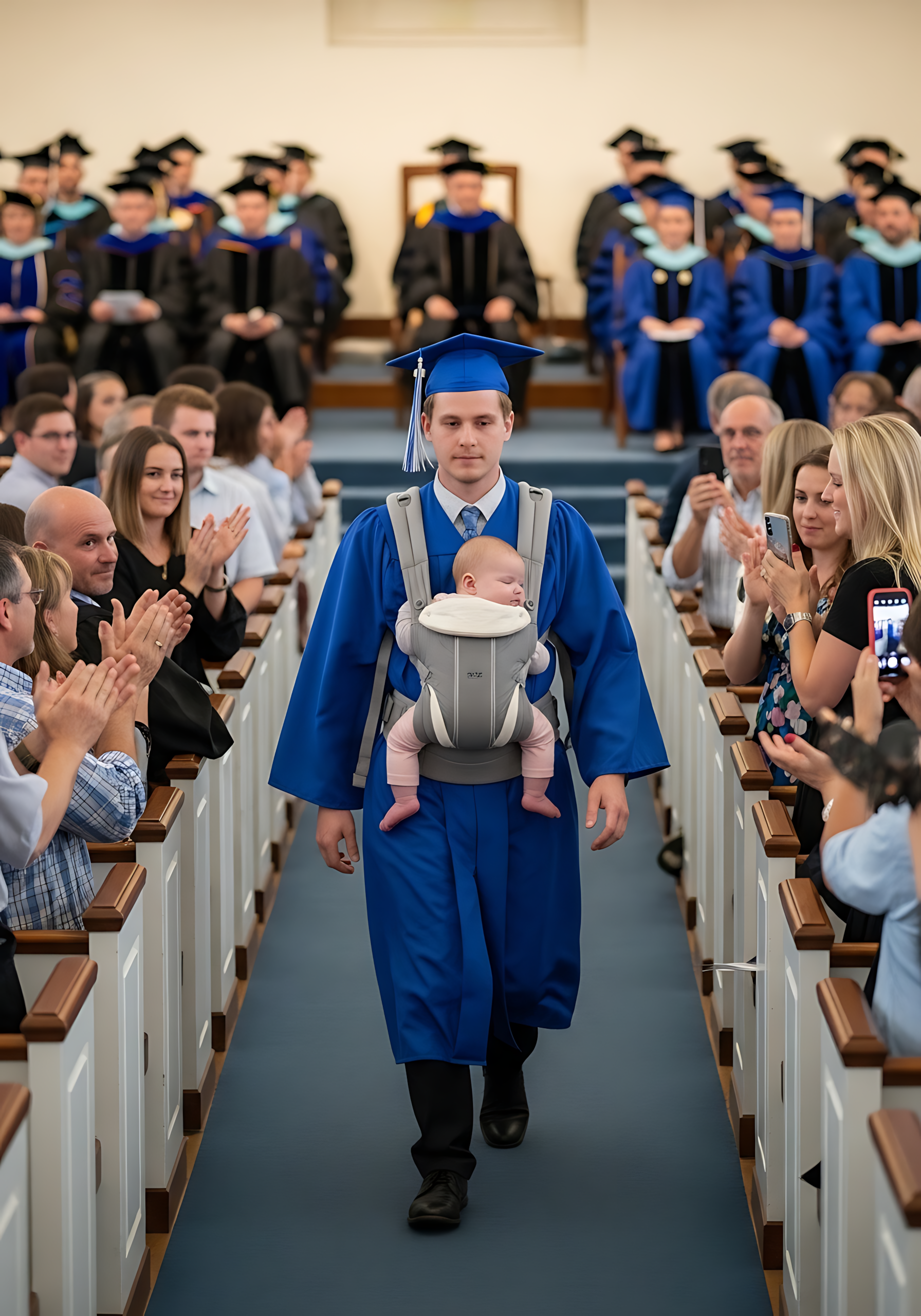
So I found myself in the school auditorium that evening with a diaper bag under my chair and Lucia Collins-Reyes sleeping against my shoulder in a borrowed infant sling that still smelled faintly of someone else’s laundry detergent.
She was so small.
That was the thing that undid me first.
Not the scandal of it.
Not the fear. Just the size of her.
Her fingers no bigger than matchsticks.
Her breath feather-light against my collarbone.
She had Diego’s mouth. I could see it already.
Around us, nobody knew what story they were sitting beside.
Or maybe they thought they did.
A few parents recognized Diego from his academic awards.
A few recognized me from years of being the woman who showed up alone.
I felt their eyes travel to the baby, then to my face, then away with that familiar, polite speed people use when they are trying to preserve your dignity without sacrificing their curiosity.
Diego had lined up backstage with the other graduates.
Before leaving me, he touched Lucia’s cheek with one finger and whispered, ‘Just a little while, Luce.
Then I’m coming back.’
I watched him go with a feeling so complicated there was no name for it.
Pride, yes. Fear, yes. Grief for the version of his life that had already ended before the diploma even touched his hand.
The speeches began. The choir sang too long.
The principal mispronounced three names in a row.
Families clapped at random intervals because they could not contain themselves.
Lucia slept through all of it, one tiny fist tucked under her chin.
Then the rows began to move.
One by one, the graduates crossed the stage as their names were called.
When it was almost Diego’s turn, he glanced toward me from the side aisle.
Our eyes met. Something in his expression made my skin go cold.
Not panic. Resolve.
He stepped out of line.
At first I thought something was wrong.
I half rose from my seat.
But instead of heading for an exit, he came straight down the side steps and stopped in front of me.
‘Mom,’ he whispered.
Before I could ask what he was doing, he held out his arms.
‘Give her to me.’
I stared at him. ‘Diego—’
‘Please.’
The principal was already calling the next name.
We had seconds. My hands moved before my mind did.
I lifted Lucia carefully and passed her into his arms.
He settled her against his chest with astonishing confidence, tucked the pink blanket higher, and slid her into the fold of his gown so only her face showed.
Then he kissed the top of her head and turned toward the stage.
The first whisper came from somewhere behind me.
The second came from my left.
By the time he reached the stairs, the whole room had noticed.
And then, because cruelty often arrives disguised as amusement, someone laughed.
It was not loud at first.
Just one sharp, disbelieving sound.
But laughter is contagious when people think they have permission.
Another joined in. Then another.
Somewhere behind me, a woman muttered, ‘Oh my God.’ A man to my right said, ‘Well, that explains the late assignments.’ Someone else, not nearly quiet enough, said, ‘Just like his mother.’
That one hit like a thrown stone.
For a second I could not breathe.
Shame is strange that way.
Even when you know you have survived impossible things, a roomful of strangers can still make you feel seventeen again.
I thought about leaving. I really did.
I thought about getting up with my empty arms and walking out before the rest of it could carve itself into memory.
But Diego never hesitated.
He climbed the stage steps with Lucia against his chest, one hand supporting her head, the other straightening his cap when it slipped.
He took his diploma from the principal, who looked stunned enough to forget the next name, and instead of exiting stage right like everyone else, he walked to the microphone set at center stage.
The room shifted.
Confusion spread first. Then silence.
Our principal, Dr. Patterson, opened her mouth as if to stop him.
Then she looked at Lucia, at Diego’s face, and stepped back.
Diego adjusted the microphone with one hand.
When he spoke, his voice carried all the way to the back of the auditorium.
‘My mother taught me what staying looks like.’
No one moved.
He swallowed once and went on.
‘Most of my life, people looked at my family and saw what was missing.
They saw a father who left.
They saw a mother who had me too young.
They saw bills, secondhand things, tired eyes, and all the reasons I should’ve ended up somewhere else.
But I grew up inside that story, and what I saw was different.
I saw my mom come home with blistered feet and still help me study.
I saw her skip meals and say she wasn’t hungry so I wouldn’t know there wasn’t enough.
I saw her stay. Every single day, she stayed.’
I had no memory of standing, but suddenly I was on my feet.
Diego looked at me, then back at the crowd.
‘A few months ago, I found out I was going to be a father.
I was scared enough to feel sick all the time.
I was ashamed too. Not because of my daughter.
Because I knew exactly what people would say when they looked at me.
Some of you are already saying it.
Maybe some of you laughed because you think this is the end of a future.
Maybe you think a baby is proof that I failed before my life even started.’
He glanced down at Lucia, who shifted against him but did not wake.
‘But this little girl is not my punishment.
She’s my responsibility. And she is not going to grow up wondering whether her father loved her enough to stay.’
Somewhere in the room, someone started crying.
Diego’s voice shook then, just once, before settling again.
‘My mom was seventeen when she had me.
People looked at her and saw a warning.
I looked at her and saw a miracle.
So if you want to know why I’m standing here like this tonight, it’s because I was raised by someone who taught me that fear is not an excuse to abandon people.
Love is not a speech.
It is rent paid late but paid.
It is showing up tired.
It is saying yes when your life gets harder.
It is staying.’
He turned fully toward me.
‘This diploma belongs to her first.
And if I become even half the parent she was, my daughter is going to be okay.’
There are pains in life so sharp they divide time.
There are other moments so full of grace they stitch those wounds without asking permission.
That was one of them.
The first clap came from the English department.
Ms. Holloway, who had taught Diego sophomore literature and once mailed him an extra copy of a novel because ours got ruined in a leak, stood up and started applauding with tears pouring down her face.
Then Coach Ramirez rose. Then Dr.
Patterson. Then the front rows.
Then the rows behind them.
Within seconds the whole auditorium was standing except for the people too embarrassed by their own laughter to trust their knees.
The sound was enormous.
Not polite applause. Not ceremonial applause.
The kind that breaks open a room.
Diego stepped away from the microphone with Lucia still tucked against him, and for the first time that night I saw him smile without any fear in it.
After the ceremony, families flooded the aisles.
Flowers, noise, congratulations, camera flashes.
I barely remember moving because people kept stopping us.
Teachers hugged Diego. Parents who had laughed would not meet my eyes.
A woman from the scholarship committee introduced herself and said they wanted to discuss emergency housing options and childcare support connected to a local foundation.
Dr. Patterson pulled me aside and told me, in a voice rough with emotion, that Diego had asked a week earlier whether the school would still let him walk if he brought his daughter to the ceremony.
She said he had made them promise not to tell me because he wanted me to have one evening before the world changed again.
One evening.
My brave, foolish son.
We drove straight from the auditorium to St.
Mary’s.
Diego still wore his cap.
Lucia slept in the car seat in the back.
My bouquet rolled across the passenger floor every time I turned.
Neither of us talked much.
Some truths are too large to process in the same clothes you wore when they broke over you.
Emma was in a hospital bed when we walked in, pale but stable, her hair damp with sweat, eyes ringed in exhaustion and apology.
She started crying the moment she saw Diego holding Lucia.
‘I’m sorry,’ she whispered. ‘I’m so sorry.
I ruined everything.’
Diego crossed the room in three steps.
‘You didn’t ruin anything,’ he said, and the certainty in his voice made me look away for a second because I felt suddenly like I was intruding on something sacred.
Emma looked at me then like she expected judgment.
Or rejection. Or the sort of cold, reasonable cruelty the world reserves for girls who become mothers before it thinks they deserve the title.
Instead I sat down beside her bed and asked, ‘Have you eaten?’
That was when she really started sobbing.
She came home with us three days later.
Not forever, not by some grand plan we announced heroically, but because there was nowhere else safe enough and because I had lived too much life to pretend morality mattered more than shelter.
We made space the only way working women do: by moving furniture, shifting schedules, and deciding sleep was a negotiable luxury.
The bassinet went beside my old dresser.
Diego took the couch for six weeks.
Emma learned where I kept extra towels.
Lucia learned the exact hour the apartment got quiet and chose that moment every night to protest it.
The place was too small, too cluttered, and too full of worry, but it was ours, and nobody in it was disappearing.
The months after graduation were not magically easy.
Anyone who tells you love solves logistics has never priced formula at midnight or tried to balance community college orientation with pediatric appointments.
Diego deferred one scholarship and kept another.
He enrolled part-time for the fall.
Emma finished her diploma requirements through an alternative program the district arranged after Dr.
Patterson intervened. I picked up two extra weekend shifts and stopped pretending I was too old to begin again.
But something fundamental had changed.
We were no longer living inside shame.
People in the community showed up.
Ms. Holloway brought freezer meals twice a month.
The grocery store manager moved Diego to better hours.
The scholarship foundation found a licensed childcare program near campus.
Keisha became family in the way blood often fails to but love does not.
Even the women at church who had once looked at me with pity now looked at Lucia with open delight and asked whether I needed a nap.
A year later, on a warm evening that smelled like cut grass and rain, I stood in our tiny kitchen while Diego fed Lucia mashed bananas with one hand and reviewed biology notes with the other.
Emma sat cross-legged on the floor filling out college aid forms.
The apartment was chaotic, cramped, and louder than the life I once thought I wanted for my son.
It was also full.
Not of failure.
Of staying.
Sometimes I still think about the laughter in that auditorium.
I think about how quickly people reach for mockery when a life does not fit the neat timeline they respect.
I think about the woman who said, ‘Just like his mother,’ as if that was the worst thing a boy could become.
She was right in one way.
He was just like his mother.
He walked toward a hard life without pretending it was easy.
He was terrified and did it anyway.
He chose love over escape.
And the night I saw my son step onto that stage with his daughter against his chest, I realized something that healed an old wound I had carried for nearly two decades.
Marco had not defined the story after all.
I had.
And now Diego was writing the next chapter with steadier hands than either of us knew he had.
The laughter did not get the last word.
My son did.