“Son, if I can’t trust you with twenty dollars, why should I trust you with anything bigger?”
I never forgot it.
I returned the money and apologized. It took time for him to trust me again, but I learned that trust wasn’t something you could demand simply because you were family.
You earned it through what you did when nobody was watching.
Jordan had spent three years doing the opposite.
And Pam had spent three years helping him hide it.
When I returned home, she was sitting at the kitchen table with two cups of coffee.
“I made yours the way you like it,” she said.
I sat down.
For a few minutes, we talked about ordinary things. The weather. The fence that needed repairing. A letter from her sister.
Then she set down her cup.
“I want to understand something,” she said.
“All right.”
“Why didn’t you ever tell me how much the storage business was worth?”
I looked at her.
“What makes you think it’s worth anything unusual?”
She shook her head.
“You’re not as difficult to read as you think, Gary. You’ve been different for a week. You’ve been taking calls outside. You brought home papers from your lawyer. And yesterday, when Jordan said you couldn’t afford legal help, you didn’t even blink.”
I almost smiled.
“You’re paying attention now.”
“Yes. I am.”
She took a breath.
“Have you sold the business?”
I didn’t answer immediately.
Then I nodded.
“Yes.”
Her eyes widened.
“When?”
“Last week.”
She stared at me.
“How much?”
I looked down at my coffee.
“Nineteen million eight hundred thousand dollars.”
For several seconds, she didn’t move.
The kitchen seemed to go silent around us.
Then she whispered, “What?”
“I sold all three storage lots. The transaction closed last week.”
She pressed her hand against her chest.
“Gary, that’s… that’s almost twenty million dollars.”
“Yes.”
“You own almost twenty million dollars?”
“Not exactly. That’s the sale price, before the final tax calculations, expenses, and other adjustments. But yes, the sale has made me considerably wealthier than I was before.”
She stared at me as though she were seeing a stranger.
“Why didn’t you tell me?”
I could have said I wanted to surprise her. That I was waiting for our anniversary. That I’d spent thirty years building the business and wanted one quiet week to myself before explaining what came next.
All of those things were true.
But they weren’t the whole truth.
“I wanted to know whether I was loved for who I was, not for what I owned.”
She looked wounded.
“Did you think I only loved you for your money?”
“No. I thought I knew you well enough to believe you didn’t. But I also wanted to understand what happened when the people around me thought I had nothing.”
She shook her head.
“You tested me.”
“I suppose I did.”
“That isn’t fair, Gary.”
“No,” I said quietly. “It isn’t entirely fair.”
I didn’t pretend otherwise.
“I should have spoken to you before the sale. I should have told you that I was considering it and explained what I planned to do. I wanted to surprise you, and I allowed that plan to become a reason to keep you in the dark.”
She wiped her eyes.
“But you didn’t have to tell me every detail of the business before you were ready.”
“No. But I should have trusted you enough to tell you about something this important.”
We sat quietly.
Then she asked the question I had been expecting.
“Does Jordan know?”
“No.”
“Are you going to tell him?”
“Not now.”
She looked toward the window.
“He’ll find out eventually.”
“Probably.”
“What will happen when he does?”
I took a slow breath.
“I don’t know.”
For the first time since the sale, I felt the full weight of the money.
It wasn’t just a number anymore. It was a test I hadn’t asked for, one that would reveal things about the people around me and perhaps about myself.
I could pay off every debt Jordan had accumulated.
I could replace every dollar Pam had withdrawn from her retirement.
I could buy a new house, a new truck, and anything else I wanted.
But I couldn’t buy back the three years Pam had spent worrying about a lie.
I couldn’t erase the signatures on those applications.
And I couldn’t make Jordan become an honest man by transferring money into his account.
“I want to do something for us,” I told Pam. “But first, we have to decide what our marriage is going to look like after this.”
She nodded.
“I understand.”
“I also want you to speak with your own financial adviser, someone independent who can help you understand what happened to your retirement and what choices you have now.”
“All right.”
“And Jordan’s debts need to be handled separately. We aren’t going to use the sale proceeds to make his problems disappear.”
She swallowed.
“All right.”
I believed she meant it.
But I also knew promises made in a quiet kitchen could be tested the moment a frightened son called his mother.
That afternoon, Jordan called.
Pam answered while I was sitting on the back porch.
I couldn’t hear his words, but I could hear her responses.
“No.”
A pause.
“Because we need to know the truth.”
Another pause.
“No, Jordan. I am not sending you money.”
Then she said something that made me look up.
“Gary sold the storage business.”
I stood.
Pam had turned away from the window, but I could hear her voice clearly now.
“Yes. He sold it last week.”
Silence.
Then Jordan’s voice rose so loudly that I could hear it through the phone.
“How much?”
Pam closed her eyes.
“That’s not the point.”
“How much, Mom?”
She looked at me through the glass.
I shook my head slightly.
She turned away.
“It’s a private matter, Jordan.”
He said something else.
Then Pam answered, “No. He is not going to pay your debts.”
The call ended abruptly.
Pam lowered the phone.
For a moment, neither of us moved.
Then she walked outside and sat beside me.
“He knows,” she said.
“I gathered that.”
“He wants to come over tonight.”
“Why?”
“He says he needs to talk to you.”
I watched a hawk circle above the field.
“Did he say anything else?”
She hesitated.
“He said he has an idea.”
I turned toward her.
“What kind of idea?”
“He says he can fix everything. He wants to explain it in person.”
I felt a familiar heaviness settle in my chest.
“Pam, I want you to understand something. We are not going to make financial decisions because Jordan has discovered I have money.”
“I know.”
“If he has a legitimate plan to repay what he owes, we’ll listen. If he wants help getting treatment for his gambling, we can discuss that too. But we are not handing him a check because he suddenly believes I can afford it.”
She nodded.
“I understand.”
That evening, Jordan arrived carrying a leather folder.
He looked different from the man who had left our house the night before. His shirt was pressed. His hair was neatly combed. He had even brought a small box of pastries from a bakery in town.
He set the box on the kitchen counter.
“Mom,” he said, “I brought your favorite.”
Pam looked at the box but didn’t touch it.
“What do you want, Jordan?”
He glanced at me.
“I want to make things right.”
“Then start with the records,” I said.
He opened the leather folder.
Inside were bank statements, a list of his debts, and a handwritten plan for repayment.
I studied the pages.
He had gathered more information than he had the night before. There were balances for the three cards, details of the rejected loan application, and a list of his current expenses.
He had also written down the amount he believed he owed Pam.
“Where did you get this?” I asked.
“I spent the day going through everything. I called the banks. I talked to my accountant.”
“You have an accountant?”
“Someone who does my taxes.”
“All right.”
I examined the list.
Some of the numbers were incomplete. A few transactions needed supporting documents. But it was a start.
“I know I can’t undo what I did,” Jordan said. “But I want to pay Mom back. I’ll sell my car. I’ll move into a cheaper apartment. I’ll get a full-time job, even if it’s not in sales. I’ll stop gambling.”
I looked at him.
“Have you spoken to anyone about your gambling?”
“No.”
“Then how do you intend to stop?”
He hesitated.
“I’ll just stop.”
“That isn’t a plan.”
His face tightened.
“I knew you would say that.”
“Because it is true. If gambling has become a problem you can’t control, you need more than a promise made at a kitchen table. You need professional support and a plan that doesn’t depend on you winning money.”
He stared at me.
For a moment, I thought he would argue.
Instead, he looked down.
“Maybe you’re right.”
Pam moved closer to him.
“Jordan, I want you to get help. I want you to have a good life. But I can’t keep paying for the consequences of your choices.”
He nodded.
“I understand.”
I placed the papers on the table.
“Here’s what I am willing to do. I’ll have Robert review the information. We’ll establish the actual balances and the accounts involved. You will cooperate with the investigations and provide every document requested. You will not open any more accounts in my name, and you will not use your mother’s retirement to cover your debts.”
He nodded.
“And the money?” he asked.
“What money?”
“The money from the sale.”
There it was.
The question he’d been waiting to ask.
I folded my hands.
“What about it?”
He looked at me, and I could see him trying to choose the right words.
“You’re sitting on a fortune, Gary. You could clear these debts in one afternoon. You could replace Mom’s retirement. You could help me start over. It wouldn’t even make a dent.”
Pam’s face fell.
Jordan continued.
“I’m not asking you to give me millions. Just enough to settle everything. Maybe a hundred thousand. That would cover the cards, the gambling debt, and some money to get my life back together.”
I stared at him.
“Yesterday, you told me I couldn’t afford a lawyer. Today, you want me to give you a hundred thousand dollars.”
“I know how it sounds.”
“Do you?”
He leaned forward.
“Gary, I’m your family.”
I looked at Pam.
She was watching him with a sadness that seemed deeper than anything I’d seen before.
Then I turned back to Jordan.
“Being family is the reason I gave you chances when you treated me like I was beneath you. It’s the reason I helped you when you lost jobs. It’s the reason I never responded when you made jokes about my truck or my work.”
He looked uncomfortable.
“But family doesn’t mean I owe you money,” I continued. “And it certainly doesn’t mean I should reward you for using my identity.”
“I’m not asking for a reward.”
“Then what are you asking for?”
“Help.”
“Help is not the same as money.”
He looked away.
I took a breath.
“I will support you in getting professional help for your gambling. I will cooperate with a reasonable repayment arrangement for money you owe your mother, once the actual amount is established. I will consider helping with necessary treatment or financial counseling, with clear limits and direct payments to the provider where appropriate.”
He looked up.
“But I will not pay your gambling debts simply because I can afford to. I will not buy your silence. And I will not promise to make the consequences disappear.”
Jordan’s jaw tightened.
“So that’s it?”
“No. That’s the beginning.”
He stood up.
“I should have known.”
“Known what?”
“That you’d use your money to control everybody.”
I felt Pam stiffen beside me.
“Sit down, Jordan.”
“No.”
He grabbed his leather folder.
“You wanted to see what kind of person I was when I thought you had nothing. Well, now you know. Congratulations.”
He walked toward the door.
I didn’t follow him.
At the threshold, he turned.
“You think you’re better than me because you built a business and saved your money. But money isn’t everything, Gary.”
I nodded.
“For once, we agree.”
He left.
Pam began to cry, but this time she didn’t run after him.
She sat beside me with her hands clasped tightly in her lap.
After a long silence, she whispered, “I think I finally understand.”
“What?”
“That every time I rescued him, I told him he didn’t have to change.”
I didn’t answer.
She looked at the door.
“I thought I was being a good mother. I thought love meant helping him no matter what.”
“Love can mean helping someone face what they’ve done.”
She nodded slowly.
“And sometimes it means saying no.”
“Yes.”
That night, Pam and I talked for hours.
We talked about the years we’d spent together, about the things we’d done well, and about the things we’d avoided. We talked about money, trust, and the difference between privacy and secrecy.
I told her I had no intention of hiding our financial situation from her going forward. We would review our plans together, with appropriate professional advice. But I also told her that trust would take time.
She didn’t ask me to forgive her immediately.
For that, I was grateful.
Over the following weeks, we began to untangle the financial mess Jordan had created.
Robert helped me work through the identity-theft process. The card companies opened investigations, and I supplied the documents they requested. I placed additional protections on my credit files and reviewed my financial accounts carefully.
Pam worked with an independent financial adviser to understand the withdrawals from her retirement account and determine what could realistically be recovered.
Jordan, after several difficult conversations, agreed to seek professional help for his gambling. He also began looking for steady work and provided additional records relating to the accounts.
Progress was slow.
Some days he cooperated. Other days he became defensive and insisted that the family should simply forgive him.
I refused to argue.
Whenever he tried to turn the conversation into a debate about whether I was being generous enough, I brought it back to the facts.
What had he done?
What needed to be corrected?
What steps was he taking to prevent it from happening again?
Those were the questions that mattered.
A month after the first confrontation, I received an update from Robert.
The investigation had confirmed enough inconsistencies in the account applications to support the fraud disputes. The companies were still reviewing individual transactions, and the final outcome wasn’t yet settled.
But one thing was becoming clear.
The situation was larger than the three cards we’d first discovered.
The rejected loan application had not been the only additional attempt to use my identity.
There were other applications and inquiries that needed to be investigated.
I sat in Robert’s office, looking at the list.
“How many?” I asked.
“We’re still verifying the full scope,” he said. “I don’t want to give you a number that may change. But you were right to investigate beyond the first three accounts.”
I felt a chill.
For years, I’d believed that my financial life was simple.
I earned money, paid bills, saved what I could, and kept records.
Now I had to examine every corner of it because someone in my own family had decided my identity was an opportunity.
When I returned home, I found Pam in the garden.
She was trimming the rose bushes along the fence. She had planted them the year after we married, and they had grown tall enough to lean over the path.
She looked up when I approached.
“How did it go?”
“There’s more to investigate.”
She set down the shears.
“More accounts?”
“Potentially. We’re verifying them.”
She closed her eyes.
“I’m so sorry, Gary.”
I stood beside her.
“I know.”
“I keep thinking about all the times I sat here and worried about you. I thought you were hiding something terrible from me. All the while, Jordan was the one hiding the truth.”
She looked at me.
“How did you live with not telling me about the business?”
I thought about that.
“I told myself I was protecting something important. But I was also avoiding a difficult conversation. I wanted to know whether people would treat me differently if they thought I had nothing, and I used silence to find out.”
“Do you regret it?”
“Parts of it.”
She nodded.
“I think we both have things to learn.”
For the first time in weeks, I felt that we were speaking honestly.
Not comfortably.
Honestly.
And sometimes that was the beginning of rebuilding something worth keeping.
Two months after I sold the storage lots, Jordan asked to meet us at a café.
He arrived early and waited at a table near the window.
He looked thinner. His clothes were plain, and he no longer wore the expensive watch he’d bought during the period when he’d been using the cards.
When we sat down, he didn’t begin by asking about the money.
He began by apologizing.
“I know I’ve said I’m sorry before,” he told us. “But I don’t think I understood what I was apologizing for.”
Pam reached across the table.
“What do you understand now?”
He looked at her.
“I made you afraid of your own husband. I took money you worked for. I made you believe a lie because it was easier than admitting I had a problem. And I used Gary’s identity because I thought I could get away with it.”
He turned toward me.
“I treated you like you were nothing because I thought your job made you nothing. I was wrong.”
I didn’t rush to answer.
He continued.
“I’ve started getting help for the gambling. I’ve been working with someone who understands compulsive gambling, and I’m learning how to deal with the urge to chase losses instead of pretending I can fix everything with one lucky win.”
He paused.
“I also got a job at a parts warehouse. It’s not glamorous, but it’s steady. I’m making payments toward what I owe Mom, and I’ve agreed to cooperate with the credit investigations.”
Pam wiped her eyes.
“I’m proud of you for taking those steps.”
Jordan nodded, though he didn’t look proud himself.
“I know this doesn’t fix what I did.”
“No,” I said. “It doesn’t.”
He looked down.
“But it’s a start.”
“Yes,” I said. “It is.”
He took a breath.
“I’m not going to ask you for money today.”
I appreciated that he said it.
“Good.”
“I’m going to pay what I owe. I know it will take time.”
“Then focus on doing that.”
He nodded.
For the first time since the night I’d overheard him in the kitchen, I saw a glimpse of the man he might become if he continued doing the difficult work.
Not the charming salesman who could talk his way out of trouble.
Not the resentful stepson who measured people by their possessions.
A man who had made a serious mistake and was beginning to understand that he couldn’t escape it by telling another story.
We didn’t embrace.
I didn’t tell him everything was forgiven.
We finished our coffee, discussed the practical steps still outstanding, and went our separate ways.
On the drive home, Pam sat quietly beside me.
“Do you think he’ll change?” she asked.
“I think he’s finally started.”
“Is that enough?”
“For today.”
She reached for my hand.
I let her take it.
By the end of the year, the investigations had progressed, and the financial picture was clearer. Some disputed accounts were corrected after review, while other matters required further documentation and follow-up. The full process was neither quick nor painless.
Jordan continued working and attending gambling-support appointments. He made payments to Pam according to an arrangement that reflected his actual income, rather than promising an impossible amount to make everyone feel better for a week.
There were setbacks.
One month, he missed a payment and avoided Pam’s calls. Another time, he admitted he’d been tempted to gamble again after a difficult day at work.
But he told the truth about it.
That mattered.
Pam learned to say no without apologizing for it. She stopped treating every crisis as an emergency she had to solve with her own money. She began rebuilding her retirement plan with professional guidance and, more importantly, began asking questions before accepting explanations.
Our marriage wasn’t magically repaired.
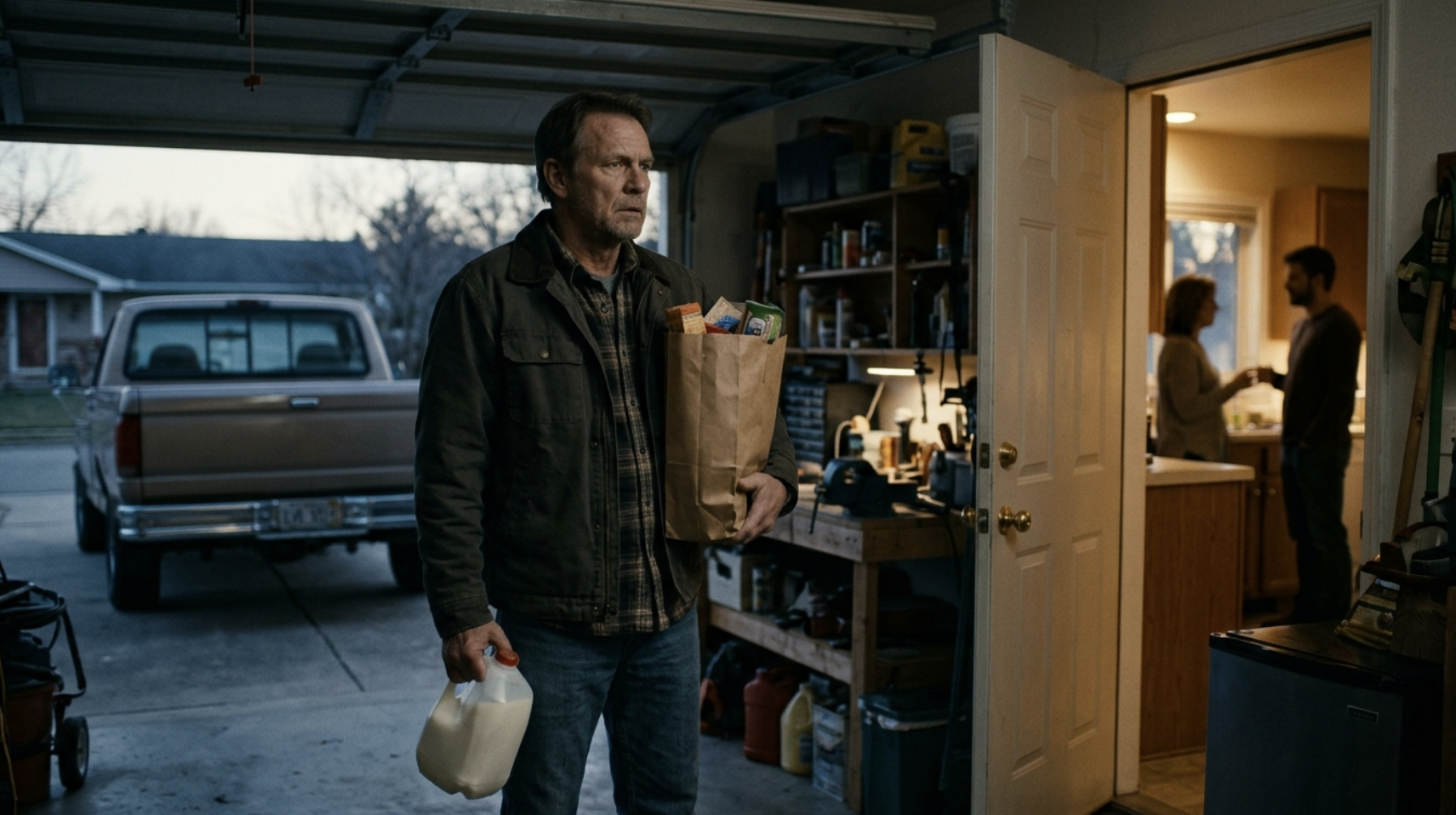
We had difficult evenings. We had conversations that circled back to the same wounds. Sometimes I remembered the kitchen doorway, the sack of groceries, and the gallon of milk in my hand, and I felt the old anger return.
When that happened, I told Pam rather than pretending everything was fine.
She learned to listen without defending herself.
I learned that honesty didn’t require me to keep every feeling locked inside until it became resentment.
We also began making plans for our future.
I bought a comfortable home on a few acres outside town, not a mansion or a sprawling estate, just a place with enough room for a garden, a workshop, and a porch where I could sit in the evening.
I bought a newer truck because the old one had earned its retirement.
I started fishing again.
And I began spending my mornings without a gate to unlock or a tenant to call.
The sale proceeds remained largely invested according to a plan developed with my financial and tax advisers. I updated my estate documents after careful consideration, making sure they reflected my wishes and the relationships I wanted to protect.
I didn’t use money to punish Jordan.
I also didn’t promise him an inheritance or make his financial future dependent on my continued generosity.
If I chose to help him in the future, it would be because he had demonstrated responsibility and because the help made sense—not because he could make me feel guilty.
As for Pam, we decided to rebuild our marriage one honest conversation at a time.
I didn’t forget what she’d done.
But I stopped using my silence as a test.
On our anniversary, I took her to the same little café where I’d eaten chicken fried steak after signing the sale papers.
She smiled when we walked in.
“Is this where you celebrated becoming a millionaire?”
I laughed.
“Technically, I was already doing all right before then.”
She rolled her eyes.
“Of course you were.”
We sat by the window and ordered our food.
After a while, she reached across the table.
“Gary, can I ask you something?”
“Anything.”
“If you could go back to the day you sold the storage lots, would you still keep it from me?”
I considered the question.
“No,” I said. “I’d still keep the details private until the deal was complete, if that was what the business required. But once it closed, I’d tell you. I’d let you be part of the decision about our future.”
She nodded.
“Thank you.”
“And if I could go back to the day I heard you and Jordan in the kitchen, I’d still investigate the accounts. I’d still protect my identity. I’d still insist on the truth.”
“I wouldn’t expect anything less.”
I looked out the window.
For years, I’d thought wealth was something you built quietly, brick by brick, by saving and reinvesting and refusing to waste what you’d earned.
I still believed that.
But I had learned something else.
Money can buy freedom from work. It can buy comfort, security, and time.
It cannot buy trust.
It cannot turn a lie into the truth.
And it cannot make someone love you for the right reasons.
The greatest surprise of that Thursday evening wasn’t the nineteen point eight million dollars in my account.
It was discovering that the people closest to me had been living inside a story that wasn’t true—and realizing that I had the choice to let that story define the rest of my life or finally insist on a different one.
I chose the truth.
Not because it was easy.
Because it was the only thing worth building on.
And every morning now, when I sit on my porch with a cup of coffee and watch the sun rise over the Texas fields, I remember the man I was when I stood in that garage holding a gallon of milk.
He thought he’d come home to an ordinary evening.
Instead, he discovered a betrayal, a fortune, and a choice.
I couldn’t change what my family had done.
But I could decide what happened next.
And for the first time in a long while, that was more than enough.
A year later, I stood on the porch of our new home, watching the Texas sunset paint the fields gold. My new truck sat in the driveway, and for the first time in decades, I had nowhere I needed to be the next morning.
Jordan had kept his job, continued getting help for his gambling, and slowly repaid his mother. Our relationship wasn’t what it had been before, but it was finally built on honesty instead of excuses.
Pam and I were rebuilding our marriage, too. Trust returned slowly, one difficult conversation at a time.
One evening, Jordan visited and found me repairing a wooden chair on the porch.
“Gary,” he said quietly, “I used to think a man’s worth depended on how much money he had. You had everything I wanted, and I couldn’t even see the kind of man you were.”
I put down my tools.
“Money can make life easier, Jordan. But character determines what you do when you think nobody is watching.”
He nodded, his eyes filling with tears.
“I hope someday you can forgive me.”
I looked at him for a long moment.
“Keep doing the right thing, even when nobody is there to forgive you. That’s how you start earning trust again.”
He shook my hand before leaving.
That night, Pam sat beside me beneath the porch light and rested her head on my shoulder.
“Do you ever regret selling the storage lots?” she asked.
I smiled.
“Not for a second.”
I’d spent thirty years building a business, but my greatest achievement wasn’t the nineteen point eight million dollars in my account. It was learning that I could walk away from betrayal without becoming bitter, protect myself without seeking revenge, and forgive someone without pretending their actions never happened.
I had lost the illusion that family could never hurt me.
In return, I’d gained something more valuable: the courage to demand honesty, the wisdom to set boundaries, and the freedom to live on my own terms.
As the stars appeared over the Texas fields, I finally understood something my father had tried to teach me years ago.
A man’s true wealth isn’t measured by what he owns, but by what he refuses to sacrifice for money—including his dignity, his peace, and his self-respect.
And at sixty-nine, with the past behind me and a quiet future ahead, I knew I was richer than I’d ever been.
