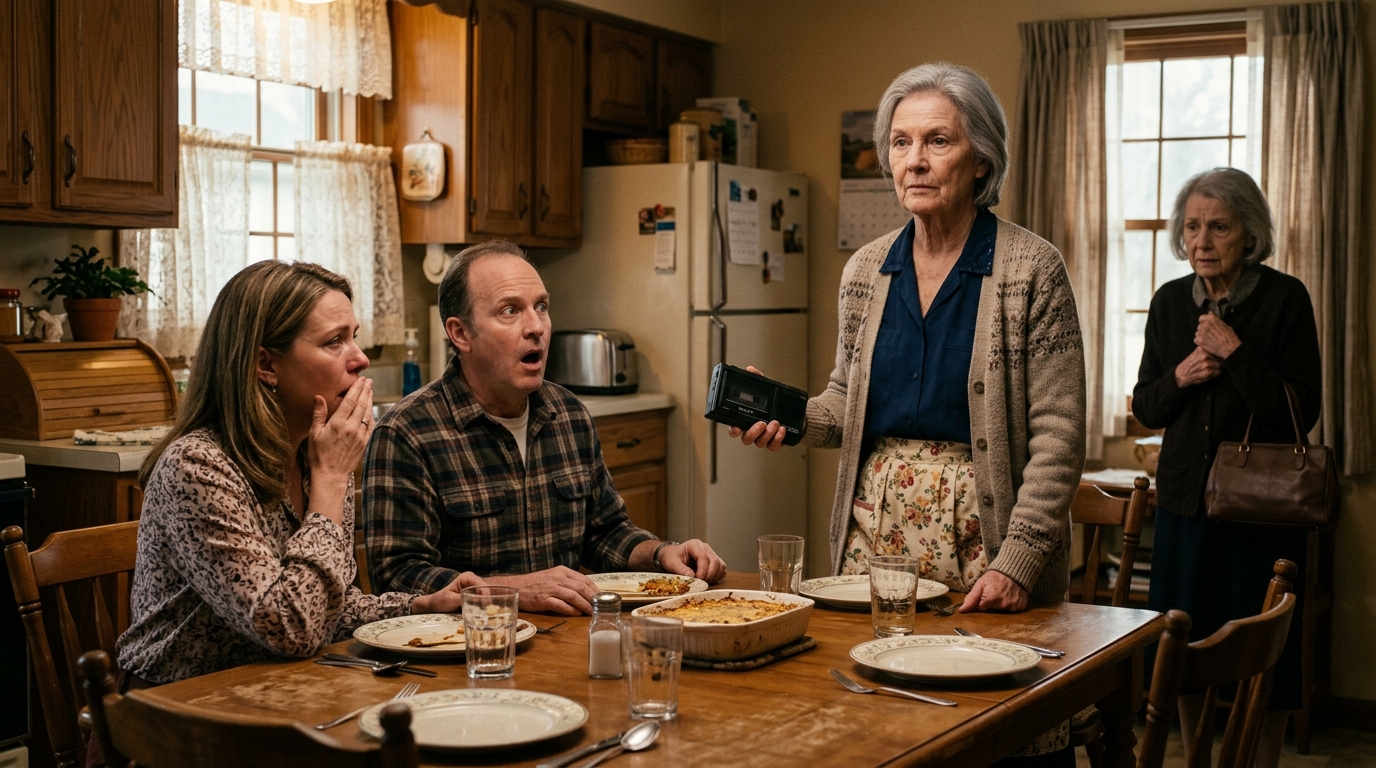
PART 32: THE JUDGE IN THE REFLECTION
Nobody in Father Donnelly’s room spoke.
The crime lab technician’s last sentence hung in the air.
“…the judge who approved the sale of Marguerite Ellis’s house four years ago.”
Linda was the first to recover.
“Repeat that.”
“The facial comparison matched with ninety-nine percent confidence.”
“The younger man reflected in the courthouse glass is the same individual who later became Judge Leonard Whitcomb.”
I frowned.
“My house sale never went before a judge.”
“It shouldn’t have,” Linda replied.
“Most don’t.”
She looked thoughtful.
“Unless…”
She stopped.
“Unless what?” Paula asked.
Linda turned toward me.
“Maggie… after Harold died, did anyone ever ask you to sign papers saying you were mentally unable to manage your finances?”
My stomach tightened.
“There was one form.”
“When?”
“The year before I sold the Ridgeway house.”
“Who brought it?”
I closed my eyes.
The memory returned.
A pleasant woman.
A clipboard.
A smile that never quite reached her eyes.
“She said the bank needed updated records because I was over seventy.”
Janice’s face went pale.
“They started preparing long before the sale.”
Linda nodded slowly.
“They were building a file.”
The sheriff folded his arms.
“If that judge appears in Harold’s evidence from twenty-eight years ago…”
“…and again during the house sale four years ago…”
“…then this wasn’t one crime.”
“It was a system.”
Father Donnelly smiled weakly.
“Harold tried to tell them.”
“No one listened.”
Thomas carefully placed the microfilm tube inside an evidence pouch.
“This is what frightened them.”
“Not the bank box.”
“Not the quilt.”
“This.”
Because if Harold had photographed every document…
…then someone had been leaving the same fingerprints on different schemes for nearly three decades.
Linda’s phone buzzed again.
It was the crime lab.
“We found something else.”
“What?”
“The sixth negative.”
“The one Harold wanted you to study.”
Linda looked at me.
“The reflection?”
“No.”
“The back of the photograph.”
Everyone frowned.
“The back?”
The technician continued.
“The negative captured the edge of another photograph lying on a desk.”
“It was almost invisible.”
“We enhanced it.”
“And?”
“There was handwriting.”
Linda held her breath.
“What does it say?”
The technician spoke slowly, reading each word.
‘Target #18 completed. Proceed to #19.’
My knees nearly gave way.
“Target…”
I whispered.
“I was Target Eighteen.”
Janice closed her eyes.
“Not was.”
Everyone looked at her.
She shook her head.
“They never stop counting.”
The room fell silent.
The sheriff’s expression hardened.
“What was Target Nineteen?”
“We don’t know yet,” Linda replied.
“But we will.”
Just then, one of the younger deputies rushed into the room carrying a tablet.
“Sheriff!”
“What is it?”
“We searched every property record connected to Harold’s list.”
“Did you find Number Nineteen?”
The deputy nodded.
“I did.”
He looked at me before speaking.
“The address wasn’t random.”
“It was only three houses away from the Ridgeway home.”
My heart skipped.
“I knew those neighbors.”
The deputy swallowed.
“The owner was an elderly widow.”
He tapped the screen.
“Her name was…”
He stopped.
His face suddenly drained of color.
“What?”
The deputy slowly turned the tablet toward us.
Displayed across the property record was a familiar photograph.
Not of the widow.
Of the attorney who had handled my house sale.
Linda stared at the screen.
Then whispered,
“He wasn’t just your attorney…”
“…he was Target Nineteen’s executor, too.”
And beneath his photograph…
…was the same tiny gold oak-tree emblem Harold had hidden in the courthouse reflection.
